By Kristina M. Launey & Minh N. Vu

Seyfarth Synopsis: AB 1757 would adopt WCAG 2.1 Level AA as the de facto standard for websites and mobile apps that can be accessed from California and impose liability for statutory damages on business establishments and website developers.

In a classic gut and amend move mid-way through the Legislative Session, on June 12 the California Assembly’s Judiciary Committee replaced the entire content of an existing bill on courts, AB 1757, with language that would effectively make WCAG 2.1 Level AA the required standard for the websites and mobile apps of “business establishments” covered by the Unruh Civil Rights Act.  And, in an unprecedented step, the bill would allow individuals with disabilities as well as business establishments to sue third party developers that create noncompliant websites and mobile apps.

The digest summarizing the bill tries to make it look business-friendly by couching it as imposing a limit on the availability of statutory damages under the Unruh Act and Disabled Persons Act (DPA) to plaintiffs.  The bill would allow plaintiffs with disabilities to recover damages where the “website fails to provide equally effective communication or facilitate full and equal enjoyment of the entity’s goods and services to all members of the public,” and the plaintiff (1) personally encountered a barrier to equal access or (2) was deterred from accessing all or part of the website or the content of the website due to the website’s inaccessibility.  However, these principles are already in existing caselaw so business establishments are not getting any new benefits from these provisions.  Instead, this bill would significantly expand the legal liability of business establishments, as well as their third party web developers, for websites and mobile apps that do not conform to WCAG 2.1 AA.

First, the bill adopts WCAG 2.1 AA as de facto standard for websites and mobile apps for the entire United States, not just California.  Under existing law, a plaintiff seeking to establish a violation of the Unruh Act based upon a website or mobile app must show that the business has violated the Americans with Disabilities Act (ADA).  This is the only avenue for establishing a violation because the California Court of Appeals has held that having an inaccessible website does not constitute “intentional discrimination,” and intent must be shown for a plaintiff to prevail on an Unruh Act claim that is not based upon a violation of the ADA.  

The ADA does not presently mandate compliance with WCAG 2.1 AA for the websites or mobile apps of public accommodations.  Instead, the ADA mandates that public accommodations provide auxiliary aids and services as necessary to ensure “effective communication” with individuals with disabilities in the provision of their goods and services.  While having a website and mobile app that can be used by individuals with disabilities is one way of ensuring effective communication, the U.S. Department of Justice (DOJ) and the courts have left open the possibility that public accommodations can ensure effective communication of the information on their websites/mobile apps in some other fashion.  In 2022, the DOJ issued a Guidance on website accessibility stating that “businesses … have flexibility in how they comply with the ADA’s general requirements of nondiscrimination and effective communication” and references WCAG as “helpful guidance.”

In addition to the “flexibility” afforded businesses under the ADA when providing “effective communication,”  a business under the ADA can claim that providing effective communication presents an “undue burden” or fundamentally alters the nature of the goods and services it provides.  AB 1757 contains no such defenses.

Thus, in contrast to the current state of the law under the ADA which would apply to an Unruh Act lawsuit, AB 1757 dictates that websites and mobile apps themselves must provide “effective communication” and a website or mobile app is presumed to provide equally effective communication if it complies with the Web Content Accessibility Guidelines 2.1 Level AA.  In short, the bill creates a de facto requirement that all websites and mobile apps that can be accessed by people in California conform to the WCAG 2.1 Level AA and contains no defenses or exceptions for undue burden.  This is a tall order considering that even federal government websites right now are only required to comply with the less demanding requirements of WCAG 2.0 Level AA (and, as DOJ recently reported, many of those websites do not). Moreover, because all websites in the United States can be accessed in California, WCAG 2.1 AA will become the de facto national standard for website accessibility.

Second, the bill contains no transition period for covered businesses.  Another troubling aspect of the bill is the absence of a transition period for business establishments and their developers to bring existing websites and mobile apps into conformance with WCAG 2.1 Level AA.  In our experience, bringing existing websites into conformance with this standard can take many months, significant resources, training of web content managers and developers, and the assistance of expensive website accessibility consultants and web developers.

Third, the bill does not address undue hardship on small businesses.  As we know, most small businesses do not create their own websites and have no understanding of how to make a website conform with WCAG 2.1 AA.  It is unlikely that they will have the resources to comply with WCAG 2.1 AA with no transition period.  Even the DOJ acknowledged in its now defunct website accessibility rulemaking for public accommodations that a transition period may be necessary and that small businesses may need a different compliance timetable.  The threat of greater legal exposure could result in small businesses taking their websites down, which could have dire consequences for their ability to drive business.

Fourth, liability for website and mobile app developers will drive up the cost of website development.  AB 1757 would give individuals with disabilities and business establishments the new right to sue web developers for creating websites that do not conform to WCAG 2.1 Level AA.  While this new cause of action will likely incentivize website/mobile app development companies to create WCAG 2.1 AA conforming websites, it will also drive the cost of website development higher and could cause small web developers out of business.

It should be noted that the language in the existing bill, AB 1757, was taken from AB 950 which died in the Assembly Appropriations Committee. That Committee Analysis found that the bill would result in various costs, including a cost of $800,000 if just 50 plaintiffs or public prosecutors brought lawsuits under the bill. While we do not track lawsuit filings in California state courts, we know from our federal court filing statistics that the Committee’s estimates on the number of lawsuits is much too low.  There were 3,255 website accessibility lawsuits filed in federal court in 2023—an all-time high.

One would think that the business community – public accommodations and website developers – would be opposing this bill or working to amend it, but we hear that business groups are supporting the bill.  We and many other defense lawyers practicing in this space are perplexed by this reaction.

AB 1757 is presently in the Senate Judiciary Committee for consideration of these amendments. If approved by the requisite committees and vote of the full Senate, the bill would then return to the Assembly for concurrence in the amendments by September 14 before going to the Governor for his approval.  If this bill becomes law in its present state, it could well open the floodgates of website and mobile app accessibility lawsuits in California.

By John W. Egan and Minh N. Vu

Seyfarth Synopsis: New York federal courts have generally been friendly to plaintiffs in website accessibility lawsuits, but a few recent decisions are demanding more of plaintiffs to establish standing.

While federal New York courts (particularly the Southern District) have historically been a friendly jurisdiction for ADA website plaintiffs, there have been a string of recent decisions dismissing website accessibility cases for lack of standing that signal judicial frustration with the plaintiff’s bar and serial filers.

Case in point:  EDNY Judge Cogan’s opinion in Winegard v. Golftec Intellectual Property LLCThe plaintiff in that case had a hearing disability and sued over non-captioned video content on the business’s website.  In granting the motion to dismiss, the Court applied the standing requirements from the Second Circuit’s decision in Calcano v. Swarovski North Am. Ltd. dismissing a consolidated case alleging that the defendants failed to provide gift cards in Braille in violation of the ADA.  Judge Cogan found that the allegations that the plaintiff visited the defendant’s website on a specific date and “on subsequent days” to attempt to watch golf-related videos was not enough to establish an intent to return to the website in the future, and further stated:

To find standing on the paltry allegations here would allow any sensory-impaired person to sit down at their computer, visit 50 websites (possibly after being referred to them by their non-sensory-impaired lawyer), and bring 50 lawsuits.  Standing requires more.

Judge Cogan also determined that “the fact that plaintiff is a serial filer” made it less plausible that his stated intent to return to the website was genuine:

With 49 cases and counting, the range of . . . [plaintiff’s] interests would have to be unusually substantial, ranging from industrial supplies to etiquette classes to robotics to freediving and spearfishing to instructions for assembling a “Nashville Hot Chicken” kit

. . . .   

While “the ADA serves the important function of facilitating full participation in American life for those with disabilities,” Judge Cogan noted, mass litigation that “allows for a quick recovery of attorney’s fees [through a settlement] with relatively minimal difficulty:”

. . . saps judicial resources, wastes attorneys’ and litigants’ time, and ultimately mock[s] the statutes mission. . . . The limited resources of the federal courts need to be marshalled for resolving genuine disputes, not to provide a platform for extracting nuisance settlements that do little, if anything, to further the important goals of the ADA.  

(citation omitted).

In Rendon v. Berry Global Inc., the blind plaintiff sued a business-to-business website for having investor relations-related content that he could not access using his screen reader. SDNY Judge Colleen McMahon dismissed the case, observing that the Second Circuit ruling in Calcano “raised the bar appreciably for adequately pleading standing to seek injunctive relief in ADA cases” (quotation omitted).  The Rendon complaint failed to allege details regarding past visits to the website or the frequency of past visits, what they were hoping to learn, why they became interested in investing, or why they planned to return.  While the Court did allow the plaintiff to file an amended complaint, it did so with the following admonishment:

If Plaintiffs can figure out a way to assert a concrete and particularized injury they are welcome to try; however I would suggest that they think about where to bring suit, as well as whether to bring suit. 

In Suris v. Crutchfield New Media, LLC, EDNY Judge Nina Morrison held that the plaintiff lacked standing because he failed to offer any factual context for his alleged intent to return to the website, as distinguished from a number of referenced cases where New York district courts found that the intent to return element was adequately pled.  The Court also determined that plaintiff’s claims were moot in any event, relying on declarations attesting that the businesses manually reviewed and remediated 4,000 videos on the website, instituted new processes to ensure that future content would be captioned, and was in the process of hiring a digital accessibility vendor.

While it remains to be seen whether these decisions indicate a shift in the legal landscape in this jurisdiction, it appears that more New York judges are getting tired of being the most favored venue for serial website accessibility plaintiffs.

By Minh N. Vu

Seyfarth synopsis:  The opening brief in Acheson Hotels v. Laufer, the first case to reach the U.S. Supreme Court in more than 18 years, was filed today.

Today, Petitioner/Defendant Acheson Hotels LLC filed its opening brief in the first ADA Title III case before SCOTUS in over eighteen years.  In our view, the decision in Acheson v. Laufer will either (1) open the floodgates for individuals with disabilities to visit businesses they do not intend to patronize in order to test and sue them for ADA non-compliance, or (2) make it a little bit harder for such individuals to sue. 

As we discussed in an earlier post when SCOTUS granted Certiorari, the question before the Court is whether a person with a disability has standing to sue a business for non-compliance with ADA requirements if that person has no interest in ever patronizing that business.    

In Acheson, the plaintiff visited the hotel’s website and alleged that it was missing accessibility information required by the ADA.  The district court concluded that the plaintiff was not injured by the alleged violation and did not have standing to sue because she had no interest in patronizing the hotel.  The First Circuit disagreed and reversed, holding that an intent to patronize the business was not necessary for standing.  We think that SCOTUS granted Certiorari because the First Circuit’s decision does not align with its more recent decisions on standing and there is a bona fide circuit split on this issue.

While Acheson is a website case, SCOTUS’s decision will also be relevant to the standing analysis for cases involving alleged physical barriers because, to have standing to sue, plaintiffs must demonstrate a desire to return to the allegedly non-compliant facilities in the future.  If plaintiffs can satisfy this requirement by simply claiming that they intend to return as testers to evaluate compliance, all plaintiffs will seemingly be able to meet this requirement.  On the other hand, if SCOTUS determines that an intent to patronize is necessary, plaintiffs will need to work a little harder to allege facts demonstrating their desire to patronize the business in the future (prior visits, their reasons for visiting, proximity to their residence, etc.). 

Plaintiff/Respondent’s brief is due August 2, 2023.  No argument date has been set.

Edited by John W. Egan

By John W. EganDov Kesselman, and Ashley S. Jenkins

A recent “Dear Colleague” letter issued jointly by the U.S. Department of Justice (DOJ) and the Office of Civil Rights of the Department of Education (OCR) places colleges and universities on notice of recent enforcement activities under Title III of the Americans with Disabilities Act (ADA) and Section 504 of the Rehabilitation Act (Section 504) directed at digital accessibility.  Referencing recent consent decrees entered into between OCR and more than 50 institutions of higher learning in just the last year, the Letter sends a clear message that institutions should meaningfully address the accessibility of their online properties and communications.

The Letter describes the increasing reliance by colleges, universities, and post-secondary institutions on not only their own websites, but also third-party social media and third-party platforms like YouTube, Spotify, and Apple Podcasts, to deliver services, programs, and activities.  It cites broad obligations to provide disability access, not only to students, but to members of the public as well.

Specifically, the Letter references the recent court-approved consent decree in an ADA enforcement action commenced by the DOJ against the University of California at Berkeley, which addressed the accessibility of Berkeley’s online content, including thousands of hours of free coursework made available to the public.  This agreement, as well as the 50-plus consent decrees that OCR entered into with covered entities over the last year that are also referenced in the Letter, have a number of common themes that provide insight into the DOJ’s and OCR’s position on these issues:

  • Digital Accessibility Standard: Adoption of an institution-wide digital accessibility standard, such as Web Content Accessibility Guidelines (WCAG), Version 2.0 or 2.1, Level AA; 
  • Broad Remedial Coverage: Requirement to audit digital properties and content via a qualified consultant.  Audit methodologies to include not only automated scanning tools, but also manual code review and testing with a screen reader.  Audit scope to cover not only university websites but also third party social media and other sites where they post content, with a corresponding remedial obligation for identified accessibility barriers;
  • New Content to Be Accessible With Institutional Controls: New content on the university website and third-party sites all subject to the institution’s selected digital accessibility standard, with certain agency reporting obligations, and the requirement to develop a plan to maintain accessibility going forward; and
  • Means To Provide Feedback: Posting of an accessibility statement and/or means for individuals to notify the university of any alleged technology-based barriers or related commentary.

Further, the Letter references a 20-part internet video series developed by OCR, which, while not exhaustive, does address digital accessibility concepts and methods of execution. It covers topics such as digital access in education, how people with disabilities use various forms of assistive technology, related federal regulations, and coding techniques for the elimination of barriers, including through the use of mini lessons.  Additionally, the Letter references the Department of Education’s intention to publish a Notice of Proposed Rulemaking (NPRM) to amend Section 504 regulations, which may address digital accessibility.

Based on these developments, now is the time for colleges and universities to review, with the advice of qualified counsel, their policies, procedures, and protocols addressing key areas of regulatory focus, such as:

  1. Accessibility of digital content on university websites and social media platforms;  
  2. Procurement of accessible technologies from third parties, such as vendors that provide athletics, library, merchandising/e-commerce functionality on institution websites;
  3. Audits for WCAG conformance and existing consultant contracts and relationships; and
  4. The terms of previous settlement agreements or consent decrees, and the institution’s ongoing compliance with these terms. 

We will continue to monitor these regulatory and enforcement activities and will provide additional reporting on future developments.

By  John W. Egan and Ashley S. Jenkins

Seyfarth Synopsis: New Kansas law will allow resident businesses to sue ADA website plaintiffs and their counsel over “abusive” litigation to recover defense fees and potentially punitive damages.

The Kansas legislature recently passed The Act Against Abusive Website Access Litigation that, starting on July 1, 2023, will allow Kansas businesses to sue ADA plaintiffs and their counsel to recover legal fees, as well as potentially punitive damages, for “abusive” website accessibility litigation commenced in any jurisdiction.  The new law allows businesses (or the State Attorney General on behalf of a class of businesses) to file claims against plaintiffs and their attorneys in a Kansas court of competent jurisdiction to recover fees incurred in the defense of out-of-state website accessibility litigation, as well as in the Kansas enforcement action.  The new law even authorizes the court to award punitive damages or sanctions not to exceed three times the fee award but does not provide any standards to guide the court in that determination (all these remedies also assume that a Kansas court would have personal jurisdiction over ADA plaintiffs and their law firms).

The new law adopts a “totality of the circumstances” test to determine if an ADA website lawsuit qualifies as abusive, which considers: (1) the number of substantially similar actions filed by the same plaintiff or firm (including those previously-declared frivolous or abusive litigation in the previous 10 years); (2) the defendant’s number of full-time employees and available resources to correct the alleged website access violation(s); (3) whether the jurisdiction or venue is a “substantial obstacle” to defending the case; (4) whether the plaintiff or his or her attorney is a Kansas resident; and (5) the nature of settlement discussions, including the “reasonableness of settlement offers and refusals to settle.” 

If the prospect of punitive damages were not enough of a deterrent for plaintiffs to sue Kansas businesses over website accessibility, the law even includes an available presumption that an ADA website case is abusive.  Specifically, when a business makes good faith attempts to cure the alleged violation after being placed on notice (either in the pleadings or otherwise) within 30 days, then the presumption applies. However, the presumption is unavailable where the business fails to correct the violation within 90 days of being placed on notice, as determined by the court.  This framework harkens back to previous failed legislative initiatives to amend the ADA to mandate that plaintiffs provide businesses with notice of violations and opportunity to cure before a case can proceed. 

The Kansas law will sunset if and when DOJ issues website accessibility regulations – which may well happen in the coming years.

As we have previously reported, website accessibility litigation is now making up a greater percentage of federal ADA Title III cases than ever before.  The litigation is highly concentrated geographically, with 92 percent of federal ADA website cases filed in only three jurisdictions last year: New York, Florida, and California.  Businesses of all shapes and sizes are often targeted, including many businesses domiciled outside of these jurisdictions.  

The Kansas law explicitly states that there are instances where website accessibility litigation “is abused for the primary purpose of obtaining an award of attorney fees for the plaintiff instead of remedying the alleged access violation,” and that “this small minority of cases . . . are almost always filed in another state’s court system against smaller Kansas businesses.”  In fact, according to our data, the entire state of Kansas only had seven ADA Title III accessibility lawsuits in 2022 and none of them were about websites.  It remains to be seen whether the Kansas law will deter website lawsuits against Kansas businesses, and whether plaintiffs, their lawyers, and the U.S. Department of Justice will challenge the law.

Edited by Kristina M. Launey 

By Minh N. Vu

Seyfarth synopsis:  A New York federal judge invokes the All Writs Act to dismiss a later-filed website accessibility lawsuit against the same defendant to protect the integrity of an existing consent decree that already requires the defendant to make its website accessible.

Businesses that are sued under Title III of the ADA for allegedly having a website that is not accessible to people with disabilities often want to know how they can avoid being sued again after settling a case.  A decision issued last week by Southern District of New York Judge Andrew Carter suggests that entering in to a consent decree which requires the defendant business to make the subject website accessible can be an effective way of deterring future lawsuits in federal court — at least for as long as the consent decree is in effect.

In Hanyzkiewicz v. Allegiance Retail Services, the defendant had entered into a consent decree to resolve a prior lawsuit alleging that its website was not accessible in violation of Title III of the ADA. The consent decree required the defendant to modify its websites “to substantially conform to Web Content Accessibility Guidelines 2.0 and/or Web Content Accessibility Guidelines 2.1 Level A Success Criteria… so that [they] will be accessible to persons with vision disabilities” by April 1, 2024.  The defendant was then sued by a second plaintiff (Hanyzkiewicz) in a new case which made the same claim as the one that had been resolved with the consent decree.  The defendant moved to dismiss, arguing that the consent decree in the first case mooted the controversy in the second case.  The Court did not agree that the matter was moot because the second complaint alleged that the website still had accessibility barriers.  However, the Court dismissed the case anyway, invoking its powers under the All Writs Act.

The All Writs Act “empowers district courts to enjoin actions brought by nonparties when doing so is necessary to protect the court’s jurisdiction over a previously entered consent decree.”  The Court found that allowing the second case to move forward “could frustrate the Court’s prior consent decree, and must be enjoined.”  The court noted that the second plaintiff had included “a proposed class that is absent from the Consent Decree and seeks materially different remedies.” Accordingly, the court found that “[t]hough plaintiff does not intend to frustrate the Consent Decree, it is entirely possible that her conduct in an ensuing litigation might disrupt the already existing Consent Decree.  It is well-settled in this district that consent decrees serve a valuable role in preventing duplicative, harassing, and perhaps frivolous litigation.”  On this basis, the Court dismissed the new lawsuit and said the second plaintiff could file a motion to enforce the consent decree under Federal Rule of Civil Procedure 71 if she had reason to believe the defendant was in noncompliance.

While not controlling precedent, this decision should deter plaintiffs from suing businesses that are already under a consent decree to make their websites accessible.  This deterrence comes with a price, however.  A consent decree is a court order, and noncompliance with such an order could result in a defendant being held in contempt and subject to sanctions.  Moreover, plaintiffs would still be able to pursue state law claims for damages in state court even if a federal consent decree is in place.  In short, when resolving a claim, defendants must consider a number of factors in deciding whether to resolve a claim with a consent decree or settlement agreement. 

Edited by Kristina Launey

By Minh N. Vu

Seyfarth Synopsis: SCOTUS grants certiorari on an ADA Title III case for the first time in 18 years to resolve a circuit split on whether an ADA plaintiff has standing to sue without having any intention of frequenting the business.

“Does a self-appointed Americans with Disabilities Act ‘tester’ have Article III standing to challenge a place of public accommodation’s failure to provide disability accessibility information on its website, even if she lacks any intention of visiting that place of public accommodation?” This is the question the defendant hotel asked the U.S. Supreme Court to decide in Acheson Hotels, LLC v. Laufer. Yesterday, the Supreme Court announced it would hear the case.  This will be the first time the Supreme Court hears an ADA Title III case in more than 18 years, and it has the potential to reshape the litigation landscape.

The First Circuit Court of Appeals in Acheson held that the plaintiff was not required to have actually intended to patronize the defendant hotel to have standing (i.e., be eligible) to sue the hotel over whether its website provided sufficient information about the hotel’s accessible features.  The Ninth, Eleventh, and Fourth Circuits have taken similar positions, finding that there is no need for a tester plaintiff to have an intent to patronize a business to have standing to file an ADA Title III lawsuit.  The Second, Fifth and Tenth Circuits, in contrast, have held that a plaintiff’s encounter with an ADA Title III violation on a website of a public accommodation does not automatically confer standing, unless there are downstream consequences resulting from the violation.  These courts require a plaintiff to show that the plaintiff wanted to patronize the public accommodation but could not because of the ADA violation on the website. 

If the Supreme Court affirms the Acheson decision and paves the way for more plaintiffs to file lawsuits without ever having to leave their homes or even feign interest in patronizing the defendant business, then the number of ADA Title III lawsuits is likely to increase substantially.  In 2022, federal courts saw the first decline in new ADA Title III lawsuit filings in the ten years that we have been tracking these statistics.  Even then, there were 8,694 such lawsuits, compared to a high of 11,452 in 2021.  On the other hand, if the Supreme Court adopts the approach of the Second, Fifth and Tenth Circuits, we doubt the lawsuits numbers will go down.  High-frequency plaintiffs and their attorneys will just have to work a little harder to persuade the courts they really want to patronize those thousands of businesses they sue each year.

Edited by John Egan

By Lotus Cannon and Minh Vu

Seyfarth synopsis:  Leading the country with 3,173 federal ADA Title III lawsuits in 2022, plaintiff-friendly court decisions will likely keep New York in the top spot.

It is no surprise that New York has become the nation’s leader in ADA Title III and website accessibility litigation, bypassing California by a substantial margin in 2022. District Court judges in New York – especially in the Southern District – have been increasingly reluctant to dismiss website accessibility lawsuits before discovery.

Cases in point: 

In Loadholt v Shirtspace, the blind plaintiff alleged that he attempted to access the defendant’s website with his screen reader to buy a T-Shirt and encountered various barriers to access.  Joining the “vast majority of courts” in the Southern District and consistent with his prior opinion in Slade v. Life Spectacular, Inc., U.S. District Judge Andrew Carter held that the defendant’s online-only business is a public accommodation covered by the ADA.  (This question has not been addressed by the Second Circuit Court of Appeals, which decides appeals from New York federal courts).  Judge Carter also found that plaintiff’s allegations regarding the barriers allegedly encountered on the website, such as multiple dead links, were sufficient to state a claim and that plaintiff’s allegations regarding the T-shirt he intended to purchase, as well as his to return to the website to purchase several T-shirts once the website is made accessible, were sufficient to confer standing. Lastly, the judge denied defendant’s request to dismiss and/or strike plaintiff’s demand for civil penalties, fines, and punitive damages under the NYCHRL as premature.

In Weekes v The Outdoor Gear Exchange, Inc., the blind plaintiff alleged he encountered various barriers on defendant’s website, which offers a variety of products for outdoor activity, that prevented him from purchasing a carry-on bag. Defendant’s website offers a live telephone customer service representative during store hours whom customers can interact with to learn about defendant’s products and facilitate purchases. U.S. District Judge Ramos found that the availability of customer service representatives as an alternative auxiliary aid had no impact on whether plaintiff had suffered an injury in-fact for standing purposes, and noted that it is unclear whether customer service representatives would even serve as an effective alternative auxiliary aid if they cannot read plaintiff’s screen and are unavailable outside of business hours. Other courts have issued similar rulings, particularly at the motion to dismiss stage.  Judge Ramos also denied Defendant’s request to transfer venue to Vermont. Notably, while the defendant did not argue that its website was an online-only business exempt from ADA requirements, the Judge cited a holding in another decision issued by a Southern District of New York judge that a website with no nexus to a physical location where goods and services are offered is a place of public accommodation under Title III of the ADA.

These decisions suggest that New York, and particularly the Southern District, will continue to lead the nation as a hotbed of Title III and website accessibility litigation.

Edited by Kristina Launey

By Ashley Jenkins & Minh Vu

Seyfarth Synopsis: After ten years, the Department of Justice (DOJ) finally issued a report on the accessibility of federal government websites which exposes widespread accessibility barriers.

The adage, “Do as I Say, Not as I Do” seems to be the motto of the federal government when it comes to compliance with digital accessibility standards.  A recent report shows that many federal agencies are not complying with Section 508’s mandate that their websites be accessible even while one of their own, DOJ, seeks to impose website accessibility mandates on state and local governments and privately-owned businesses under Titles II and III of the Americans with Disabilities Act (ADA).

On February 21, 2023, DOJ released its first report on the federal government’s compliance with Section 508 of the Rehabilitation Act in ten years.  Section 508 requires federal agencies to ensure that their websites and other information and communication technologies are accessible to individuals with disabilities. Section 508 also requires the DOJ to submit a report to the President and Congress every two years regarding compliance with this requirement. 

Senator Bob Casey (D-PA) blasted the recently-released data in a press release, making the following observations about the report: 

  • “One in 10 public-facing websites at major federal departments and agencies are not fully accessible for people with disabilities. Three in five internal websites at major federal departments and agencies are not fully accessible to people with disabilities.”
  • “The Department of Agriculture, Department of Labor, Department of State, and Department of Veterans Affairs reported that 50 percent or less of the public-facing websites that were tested comply with federal accessibility requirements.”
  • “Some departments and agencies did not report conducting any accessibility testing of internal websites. It [is] not clear what steps departments and agencies are taking to test other types of technology covered by Section 508 of the Rehabilitation Act.”
  • “DOJ found that key government agencies, including DOJ itself, as well as the Department of Agriculture, the Department of Defense, and the Environmental Protection Agency did not have adequate ‘resources committed and/or staff trained to implement policies, processes, and procedures.’ These shortfalls in staffing were reflected in data regarding the low number of federal and contract employees directly supporting Section 508 programs in many agencies.”
  • “DOJ also found that ‘[a]gency maturity remains largely unchanged from prior reporting,’ raising concerns that, despite over a decade of technological evolution, many federal government agencies have not made efforts to improve and better integrate Section 508 compliance and ensure the federal government’s resources are available for people with disabilities, including taxpayers and federal workers.”

The findings are not surprising because ensuring that websites are accessible to individuals with disabilities requires a substantial and ongoing commitment of resources which even the federal government seems to lack.  Nonetheless, the DOJ has in the past two years ramped up its enforcement efforts to compel private businesses to comply with accessibility standards and put in place rigorous website testing and monitoring efforts.  Private plaintiffs have also been extremely active, filing a record 3,255 website accessibility lawsuits in federal court against private businesses in 2022.  This latest data from DOJ is further evidence that DOJ needs to adopt reasonable website accessibility standards for public accommodations that recognize the real challenges that businesses face in making and keeping their websites accessible. 

Edited by Kristina Launey

By Minh VuKristina Launey and Susan Ryan

Seyfarth Synopsis: The number of ADA Title III lawsuits filed in federal court dropped by 24 percent, the lowest since 2017, and California is no longer the epicenter.

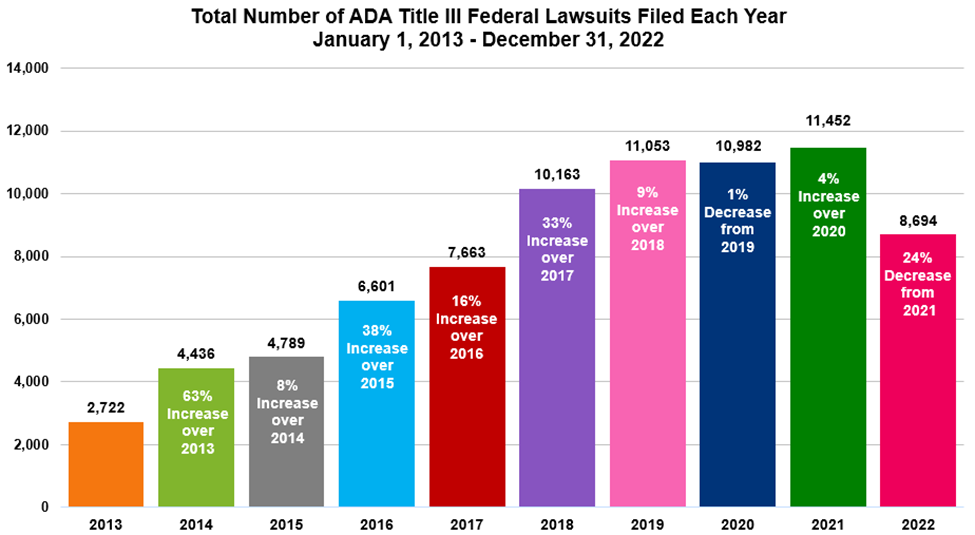
ADA Title III case filings in federal court had been on a sharp upward trajectory since we started compiling these statistics in 2013. That year, there were only 2,722 lawsuits nationwide.  Eight years later, in 2021, there were 11,452 such lawsuits.  In-between, year over year increases ranged from 4% to 63%.  2020 was the only “down” year, with a 1% slight decrease which was likely attributable to pandemic restrictions. 

We now have a second, far more significant, “down” year.  In 2022, Plaintiffs filed 8,694 Title III lawsuits in federal courts, a drop of 2,758 cases, or 24.1%, from 2021.  However, compared to the 2,722 total lawsuit count in 2013, 8,694 lawsuits is still a very significant number of lawsuit filings for a fairly discrete area of the law, and marks an astounding 319% increase from 2013. 

[Total Number of ADA Title III Federal Lawsuits Filed Each Year January 1, 2013 – December 31, 2022: 2013:  2,722; 2014: 4,436 63% increase over 2013; 2015: 4,789 8% increase over 2014; 2016: 6,601 38% increase over 2015; 2017: 7,663 16% increase over 2016; 2018: 10,163 33% increase over 2017; 2019: 11,053 9% increase over 2018; 2020: 10,982 1% decrease from 2019; 2021: 11,452 4% increase over 2020; 2022: 8,694 24% decrease from 2021]

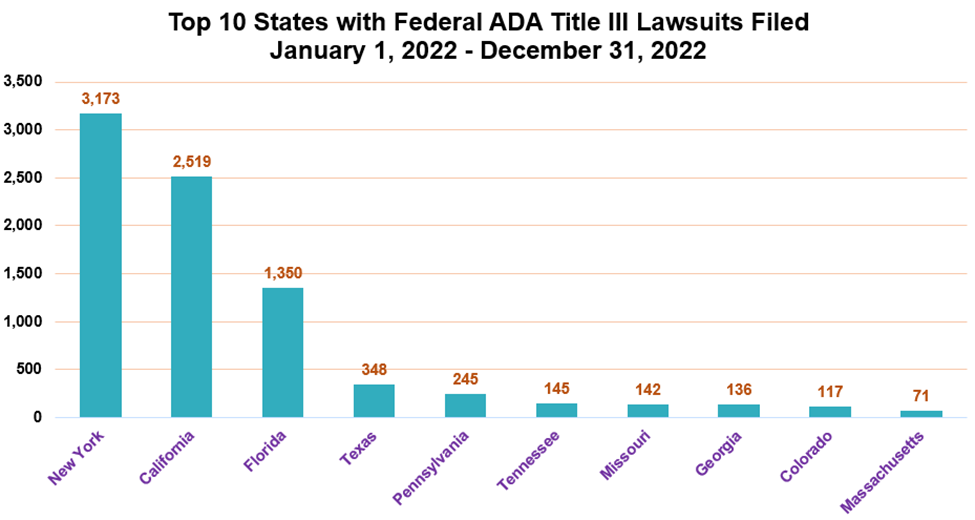
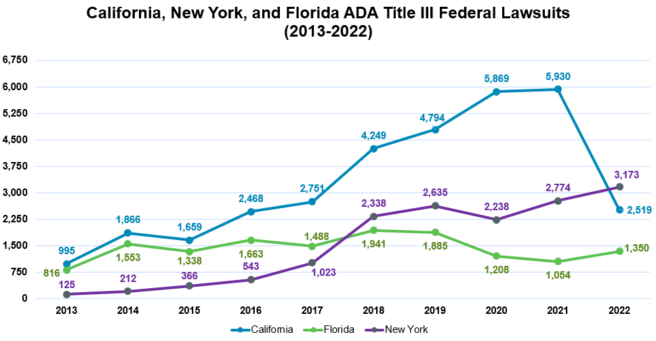
The other big news is that California – the historical leader in ADA Title III litigation – has fallen behind New York.  Plaintiffs filed 3,173 cases in the Empire State compared with 2,519 in the Golden State.  Third on the list was Florida with 1,350.  Rounding out the top five (well behind the leaders) were Texas with 348 and Pennsylvania with 245 lawsuits.  Sixth through tenth places went to: Tennessee (145), Missouri (142), Georgia (136), Colorado (117) and Massachusetts (71).  (Missouri is a newcomer to the top ten.)  Nevada and Illinois dropped out of the top 10.  Illinois came in at number 11 with 63 cases and Nevada plummeted to 4 cases from 130 in 2021.

[Top 10 States with Federal ADA Title III Lawsuits Filed January 1, 2022 – December 31, 2022:  New York: 3,173; California: 2,519; Florida: 1,350; Texas: 348; Pennsylvania: 245; Tennessee: 145; Missouri: 142; Georgia: 136; Colorado: 117; Massachusetts: 71]
[California, New York, Florida ADA Tile III Federal Lawsuits 2013-2022: California: 2013: 995; 2014 1,866; 2015: 1,659; 2016: 2,458; 2017: 2,751; 2018: 4,249; 2019: 4,794; 2020: 5,869; 2021: 5,930; 2022: 2,519; Florida: 2013: 816; 2014: 1,553; 2015: 1,338; 2016:1,663; 2017: 1,488; 2018: 1,941; 2019: 1,885; 2020: 1,208; 2021: 1,054; 2022: 1,350; New York: 2013: 125; 2014: 212; 2015: 366; 2016: 543; 2017: 1,023; 2018: 2,338; 2019: 2,635; 2020: 2,238; 2021: 2,774; 2022: 3,173]

The states with no federal ADA Title III filings in 2022 were Alaska, Iowa, North Dakota, South Dakota and Vermont.

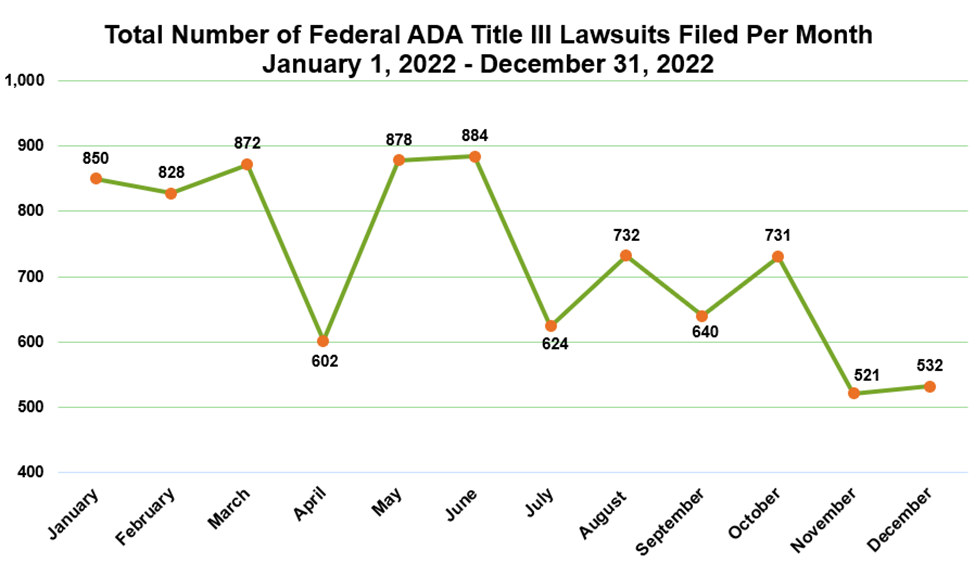
The end of the year was the least busy time for filings – November and December had 521 and 532 filings respectively.  The busiest months?  June (884), May (878) and March (872).  The year started out busy, but dropped precipitously in the second half.

[Total Number of Federal ADA Title III Lawsuits Filed Per Month January 1, 2022 – December 31, 2022: January: 850; February: 828; March: 872; April: 602; May: 878; June: 884; July: 624; August: 732; September: 640; October: 731; November: 521; December: 532]

So what’s behind this decrease in filings?  As we discussed in a post about the mid-year lawsuit numbers, one prolific plaintiff’s firm in Southern California was sued by the Los Angeles and San Francisco District Attorneys which may have slowed down their filings.  That lawsuit was dismissed by the trial court (an appeal has been taken) so that firm may return to its normal pace of filings in 2023.  Several attorneys from that firm also left to form their own firm which will likely result in additional filings in California.  Furthermore, the Ninth Circuit Court of Appeals issued a decision in October 2022 that was unfavorable to plaintiffs’ attorneys which might have had a chilling effect for the rest of the year.  Unfortunately for businesses, a different panel of the Ninth Circuit reversed course in January 2023 when it issued a decision which will likely cause a surge in new filings by serial plaintiff “testers” unless it is rescinded.  The defendant in that case has filed a Petition for Rehearing En Banc which is under consideration.

We should note that federal website accessibility lawsuits accounted for 37% of the 8,694 ADA Title III lawsuits filed in federal court in 2022 – the largest percentage ever.  This is not surprising because serial plaintiffs can visit websites for the purpose of filing a lawsuit without even leaving their house. Lawsuits involving physical barriers typically require a visit to the place of business.

A note on our methodology: Our research involved a painstaking manual process of going through all federal cases that were coded as “ADA-Other,” manually culling out the ADA Title II cases in which the defendants are state and local governments, and categorizing them by state.  The manual process means there is the small possibility of human error.