By Minh N. Vu & John W. Egan

Seyfarth Synopsis:  SCOTUS’s refusal to clarify standing requirements for “tester” plaintiffs in ADA Title III lawsuits means it’s business as usual for the plaintiffs’ bar. 

Yesterday, SCOTUS issued its decision in Acheson v. Laufer which – to the disappointment of private businesses and the defense bar – leaves unanswered the question of whether individuals who visit websites and businesses for no other reason than to evaluate their compliance with Title III of the ADA (i.e., so-called “testers”) have standing to bring a lawsuit.  While SCOTUS said it had the discretion to decide this very important question of tester standing, on which the U.S. Courts of Appeals are divided, it declined to do so because Laufer mooted the case by dismissing it at the District Court (along with all her other pending ADA Title III cases) after SCOTUS said it would review the case.  At oral argument two months ago, Defendant Acheson had urged SCOTUS to decide whether Laufer had standing nonetheless, pointing out that Laufer should not be permitted to evade a potentially unfavorable decision (and manipulate the Court’s jurisdiction in the process), by voluntarily dismissing her case with prejudice. 

Justice Barrett authored a brief opinion for the majority in which Chief Justice Roberts, and Justices Alito, Sotomayor, Kagan, Gorsuch, and Kavanaugh joined.  That opinion credited Laufer’s claim that she had dismissed her lawsuit because one of her former attorneys had been sanctioned, rather than to evade the Court’s review.  The majority noted that Laufer represented to the Court that she would not file any other cases but emphasized that the Court might exercise its discretion differently in a future case. 

In his opinion concurring only in the judgment, Justice Thomas found Laufer’s explanation implausible and concluded that she dismissed her case as a “transparent tactic for evading review” by the Court.  He pointed out that the sanctioned attorney had never served as her counsel in the case.  He added: “[W]e have needlessly invited litigants to follow Laufer’s path to manipulate our docket.  We should not resolve this case about standing based upon mootness of Laufer’s own making.”  Justice Thomas went on to conclude that Laufer did not have standing because the alleged violation on the website (i.e. deficient accessibility information about the hotel) caused her no harm, as she never had any interest in staying at the hotel.  He then described the dangers of ADA testers who seek to vindicate the public interest, but do not have the accountability of the Executive Branch.  Without a violation of her own rights, he explained, Laufer was able to, without any discretion required of a government official, “surf the web” to ascertain compliance of hotels she had no intention to visit and obtain monetary settlements from businesses seeking to avoid substantial defense fees.  Justice Thomas concluded that these activities go far beyond the role for private plaintiffs that Congress envisioned in ADA Title III cases.     

Justice Thomas did join the majority with regard to the judgment which was to remand the matter with an order to dismiss and vacate the decision by the First Circuit Court of Appeals.  Justice Jackson, writing separately, agreed with the majority that the case was moot but wanted to leave in place the First Circuit Court of Appeal’s “pro-tester” ruling.

SCOTUS’s failure to settle the issue of tester standing should be very frustrating to private businesses which, in the past five years (2018-2022), have been hit with an average of 10,468 ADA Title III federal lawsuits a year.  Thousands of those suits are filed by tester plaintiffs whose stated desire to patronize the businesses they sue is highly questionable.  Few businesses have the resources to litigate a case all the way to SCOTUS.  Most businesses settle early to avoid incurring legal fees.  Thus, it is unlikely that this question will reach SCOTUS again for many years, especially when – like Laufer – plaintiffs can evade review by voluntarily dismissing their cases when faced with a potentially unfavorable judgment that could impact their future filings.

The bottom line is that tester plaintiffs and their attorneys will continue to bring cases in those jurisdictions where the standing rules are less demanding such as the Fourth Circuit. The situation is somewhat unclear in the First and Eleventh Circuits because – while those circuits had adopted a less demanding standard – the decisions adopting that standard have both been vacated on mootness grounds.  Tester plaintiffs in the Second, Fifth, and Tenth Circuits will continue to face stricter standing requirements.  Meanwhile, the Court of Appeals for the Ninth Circuit is contemplating whether to reconsider its decision in Langer v. Kisor which favors tester plaintiffs.  The Ninth Circuit had put on hold its decision on the Petition for Rehearing en banc to see how SCOTUS would rule in Acheson, and the court is now likely to move forward with its decision soon.

By: Kristina Launey and Minh Vu

Seyfarth Synopsis: The Sixth Circuit Court of Appeals approved state-owned hospital’s exclusion of nursing student’s service animal that posed a direct threat to patients and staff with severe allergies where no reasonable alternatives existed to mitigate the threat.

The Sixth Circuit Court of Appeals recently issued a decision in Bennett v. Hurley Med. Ctr. concerning the use of a service animal in a state-owned hospital under Title II of the ADA that provides useful guidance on how health care facilities should assess whether a service animal poses a direct threat to the health and safety of others. This decision is also relevant for private health care facilities because the direct threat analysis is the same under Title III of the ADA.

The plaintiff was a nursing student who worked at a hospital as part of her educational program for four hours once a week for six weeks. She has a panic disorder and her service dog was trained to recognize symptoms of a forthcoming panic attack so that she could immediately take her medications.  

The hospital at first approved the student’s request that her service dog accompany her on her rotation. However, on the very first day one staff member and one patient experienced allergic reactions to the dog. In response, the hospital revoked its approval of the service animal. The hospital offered the alternative accommodation of crating the service dog on a separate floor from those with allergies in the hospital and plaintiff taking necessary breaks to be with the service dog. The hospital had determined that relocating patients and staff with dog allergies from the floor where the plaintiff had to work (her university program supervisor was on that floor) would be unworkable and directly compromise patient care.

The court first held that the hospital had not engaged in intentional discrimination by refusing to allow the plaintiff to have her dog accompany her on rotations. The court concluded that the hospital’s decision was motivated by staff and patient complaints of allergic reactions to the dog – not the disability.

The court then considered whether the hospital had violated Title II of the ADA by not modifying its policy to accommodate the service dog on Plaintiff’s rotations. After reviewing the DOJ’s implementing regulations, DOJ guidance, and “scant” relevant case law to determine what constitutes reasonable accommodation of a service animal in a healthcare setting, the court concluded that “service animals are permitted as a reasonable accommodation unless they are ‘out of control,’ ‘not housebroken,’ would fundamentally alter the activities of the public entity, or, if, after conducting an individualized assessment of the animal, the public entity concludes that the service animal poses a direct threat.” The court then concluded that the service dog’s presence did constitute a direct threat because of the actual allergic reactions that took place and the lack of a workable alterative to mitigate that threat. Specifically, the court found that separating the service dog from allergic patients and staff was not possible.

While this decision provides helpful guidance to health care facilities on the issue of service animal access, it should not be viewed as license to exclude service animals from such facilities. The U.S. Department of Justice has taken the position that blanket exclusions of service animals from health care facilities are not permissible, consistent with the principle that exclusions based on the direct threat defense must be based on an individualized assessment of the circumstances presented. Here, there was concrete evidence of the direct threat and the hospital demonstrated that there was no way to mitigate it.

By Minh N. Vu and John W. Egan

Seyfarth Synopsis:  SCOTUS asked revealing questions in yesterday’s Acheson v. Laufer oral argument, but left attendees wondering whether the Court will provide much-needed guidance on the so-called “tester standing” issue for which it granted certiorari.

The U.S. Supreme Court (SCOTUS) heard oral argument yesterday in a case arising under Title III of the Americans with Disabilities Act (ADA) for the first time in eighteen years to decide whether a “self-appointed [ADA] tester” has standing to challenge a place of public accommodation’s alleged failure to provide legally required disability accessibility information on its website, even if she has no intention of visiting that business.  However, at least half of the argument focused on whether the Court should decide this issue at all because Plaintiff/Respondent Laufer dismissed the underlying lawsuit after SCOTUS granted Defendant/Petitioner’s request to consider the question.  

Some background is in order.  The Plaintiff/Respondent, Deborah Laufer, filed a lawsuit (one of over 600 similar lawsuits she had filed according to her Petition for Certiorari) alleging that she visited the website of the Defendant/Petitioner Acheson Hotel (“Acheson”), and found it was missing information regarding accessibility features of the hotel required by the ADA.  She admittedly had no intention of ever visiting the hotel and had reviewed the website for no reason other than to test its compliance with the ADA regulations.  

The district court concluded that encountering the ADA violation without any intent to visit the hotel was not sufficient for Laufer to establish the injury required for her to have standing to pursue the case.  The U.S. Court of Appeals for the First Circuit disagreed and reversed, holding that an intent to visit the business was not necessary for standing.  Laufer’s encounter with the allegedly deficient information on the website was a sufficient injury to establish standing to sue, the First Circuit ruled.

After SCOTUS agreed to hear the case, Laufer dismissed her case in the district court and then asked SCOTUS to dismiss her case as moot.  Acheson vigorously opposed the request, arguing that Laufer had deliberately abandoned her claims to avoid a potential decision overturning the First Circuit’s very plaintiff-friendly standing precedent.  SCOTUS declined that request, stating that the issue of mootness would be considered at oral argument, along with the original question presented.  Then, on September 20, 2023, to further her mootness argument, Plaintiff filed a brief informing SCOTUS that the property at issue had been sold and Acheson no longer owned the hotel.

This was the state of play going into the oral argument yesterday, with counsel for Acheson, Laufer, and the United States presenting their arguments to the Court.

The two issues that dominated the argument were:

  1. Should the Court address whether Laufer had standing as a tester or simply declare the matter moot and not address the standing issue?
  2. On the standing question, when has a plaintiff suffered an injury sufficient to have standing when the violation is on a website?

Justice Thomas teed up a vigorous round of questioning by almost all the Justices on the mootness issue by asking Acheson’s counsel why the Court should decide the standing issue now that the case is moot.  Justices Sotomayor, Jackson, and Kagan seemed most inclined to declare the matter moot and not address the tester standing issue.  Justice Kagan said it felt “unjudicial” to consider a case that was “dead as a doornail” and said the case was “dead, dead, dead” in “all the ways a case can be dead.” 

Chief Justice Roberts, on the other hand, seemed concerned that a plaintiff could manipulate the process to keep SCOTUS from addressing the tester standing issue.  Justice Barrett seemed to share his concern, noting that Laufer had voluntarily dismissed the judgment she received in the Eleventh Circuit in a different case which had the effect of reducing (but not eliminating) the number of conflicting appellate circuit decisions on the question of tester standing.  Justice Alito suggested that a decision from SCOTUS on the issue was important given the split among the circuits on the issue of tester standing.  The viewpoints of Justices Gorsuch and Kavanaugh were not readily apparent.  Despite the apparent differences of opinion among some of the Justices on whether they should decide the tester standing issue, they and the parties appeared to agree that SCOTUS has the authority and discretion to address it, even if the case is moot.

On the issue of tester standing, the Justices posed a flurry of hypotheticals to counsel for the parties and the United States to ferret out their positions.  Under what circumstances does a plaintiff encountering a violation on a website suffer an injury sufficient to establish standing?  Counsel for Laufer took the position that encountering a violation on a website is itself sufficient to establish standing irrespective of the intent for visiting the site and any consequences flowing from that encounter.  The United States seemed to take a similar position.  Acheson disagreed.  Not surprisingly, the liberal Justices seemed more open to a less demanding standard for standing than their conservative counterparts.

SCOTUS concluded oral argument with no clear indication of whether or how it will rule on the tester standing issue, but it was clear that some Justices support a substantive ruling on the issue to clarify the law now.  As ADA specialists, we do hope the Court will address the question, as clarity and uniformity of the law are important for plaintiffs and defendants alike.

Edited by: Kristina Launey

By: John W. Egan and Ashley S. Jenkins

Occasionally we see a story in the news that we can’t resist blogging about, and this one is no exception:  Last week, an emotional support alligator named “Wally” was denied access to Citizens Bank Park in Philadelphia to watch a professional baseball game.  We thought this would be a nice opportunity to remind our readers about the difference between an emotional support animal (ESA) such as Wally, and a service animal.

As the story goes, Wally (a six-foot long, 55-pound alligator, equipped with a red harness and leash that boasts an impressive following on social media) and his owner were invited to the stadium by the Philadelphia Phillies to meet the team. When they arrived at the stadium too late to meet the players, a friend of Wally’s owner bought tickets so could stay for the game. While waiting in line, stadium employees informed Wally’s owner that the stadium allows service animals, but not emotional support animals (even if they are purported hug-giving, couch-laying alligators). The owner did not object and stressed in the article that he and Wally were only there because they had been invited by the Phillies in the first place and did not claim that Wally is a service animal.

The stadium was correct that it did not have to allow Wally the ESA into the stadium.  Under the Americans with Disabilities Act (ADA), public accommodations such as the stadium are only required to allow service animals entry, as the U.S. Department of Justice has explained in this useful FAQ.    

So, in case you have an emotional support alligator, llama, cockatoo, pig, marmot, peacock, or other domesticated (or wild) creature that shows up at the door of your business, here’s a quick primer on the difference between an ESA and a service animal:

ESAs Are Not Service Animals

The ADA defines a service animal as a dog that is individually trained to do work or perform tasks for people with disabilities.  Public accommodations must allow service dogs to accompany customers with disabilities in all areas of a facility where the public is allowed to go.  In addition, while miniature horses are not technically service animals, the ADA regulations require that public accommodations allow miniature horses that perform work or tasks for individuals with disabilities into their facilities just like service dogs, except they are subject to certain weight and size limitations.  Businesses should also keep in mind that most states recognize service animals in-training that are with their trainers as well. 

In contrast, ESAs provide comfort and support to their owners by being present, but they are not trained to perform any work or task.  We note, however, that dogs or miniature horses that are trained to perform work or tasks relating to a psychiatric disability (e.g. reminding someone to take their medications or taking affirmative action in the event of a panic attack) would be considered a service animal and must be allowed to accompany its owner into a public accommodation.

Unlike the ADA, the Fair Housing Act (FHA) recognizes ESAs as “assistance animals”—defined as any “animal that works, provides assistance, or performs tasks for the benefit of a person with a disability, or that provides emotional support that alleviates one or more identified effects of a person’s disability.” The FHA requires housing providers to allow ESAs as a reasonable accommodation (regardless of any pet restrictions) when a resident makes a request that is supported by reliable disability-related documentation or when the disability-related need for the animal is apparent.  

The bottom line is that public accommodations do not have any obligation to admit an ESA.  

There Are Only Two Questions You Are Allowed To Ask

When a customer with a purported service animal enters (or attempts to enter) a public accommodation, there are only two questions that can be asked if it is not obvious that the animal is a service animal: (1) Is the animal required because of a disability? and (2) What work or task has the animal been trained to perform?

One misunderstanding we hear often is the expectation that the animal must have documentation.  Under the ADA, public accommodations are not allowed to request any documentation at all.  And remember, public accommodations also cannot ask for a demonstration of the tasks the animal performs or inquire about the nature or extent of the customer’s disability.  

A public accommodation also cannot charge any special fees related to the animal (including pet fees) but can charge for damage caused by the animal if it normally charges for such damages.  The business also has no obligation to care for or supervise a service animal.   

Limited Reasons Why You Can Exclude A Service Animal  

The ADA requires that service animals be under the control of their handler at all times. This means that the animal is harnessed, leashed, or tethered while in public places, unless these devices interfere with the service animal’s work or the person’s disability prevents their use. In those instances, the handler must use voice signals or other effective means to maintain control of the animal.

There are limited circumstances when a business can ask a person to remove a service animal from its premises.  They are: (1) if the animal is out of control and the handler does not take effective action to control it; or (2) if the animal is not housebroken.  In either instance, the business must invite the customer back without the animal or allow the customer to remain on the premises without the animal.

*                        *                        *

Finally, it is important to remember that service animals do important work and the tasks they are trained to perform are absolutely essential for people with disabilities.  By one account, training a guide dog can take 3 years and can cost up to $50,000 annually.  These types of trained, working animals must be admitted under Title III of the ADA for good reason.    

Edited by:  Minh N. Vu

By Kristina M. Launey

Seyfarth Synopsis: AB 1757, which would set a standard for website accessibility for businesses in California, has been held in the Legislature to resume discussion in 2024.

While Southern California and Burning Man revelers were hit with unprecedented severe storms in August, the California Legislature has given businesses at least a temporary reprieve from legislation that would likely have caused a tsunami (of lawsuits) of its own. 

As we reported, AB 1757, was seemingly well-intentioned to provide clarity around how websites must be coded to be considered accessible to individuals with disabilities and thus in compliance with the Unruh Act and Disabled Persons Act – California’s corollaries to the Americans with Disabilities Act.  However, as drafted, it had some serious shortcomings that may well have resulted in even greater litigation and liability for businesses than we’ve already seen, and newly-imposed liability on website and mobile app developers.

On August 21, 2023, the bill was held in Senate Appropriations committee at the request of the bill’s author. 

While the storm has passed for now, we expect to see this bill’s return in 2024 and hope revisions will be made to actually accomplish the bill’s stated goal of reducing lawsuits while increasing accessibility and providing useful guidance to businesses.

Edited by Minh N. Vu

By Minh Vu, Kristina Launey, and Susan Ryan

Seyfarth Synopsis: The decline in ADA Title III lawsuits that began in 2022 continues in 2023.  New York remains the filing hotspot.

Continuing the trend discussed in our 2022 blog posts here and here, the number of lawsuits filed in federal courts alleging violations of Title III of the Americans with Disabilities Act (ADA) is decreasing from its 2021 high.  2022’s final numbers showed 24.1% fewer cases filed than in the previous year.  Thus far into 2023, the numbers are even fewer.  4,081 cases were filed between January and June of this year, representing a 17% drop from the 4,914 cases filed between January and June 2022.

[Mid-Year ADA Title III Federal Lawsuit Filings 2017-2023: 2017: 4,127; 2018: 4,965, 20% Increase from 2017; 2019: 5,592, 12% Increase from 2018; 2020: 4,751, 15% Decrease from 2019; 2021: 6,304, 33% Increase from 2020; 2022: 4,914, 22% Decrease from 2021; 2023: 4,081, 17% Decrease from 2022]

The number of federal lawsuits filed in the first six months of this year is lower than the number of suits filed in 2017 for the same period.  That is quite a dramatic change. 

The drop in California federal lawsuit filings is just as stark:  California federal courts only saw 1,020 lawsuits for the first half of this year, as opposed to the first half of 2022 when there were 1,587.  That’s a 35.8% decline.

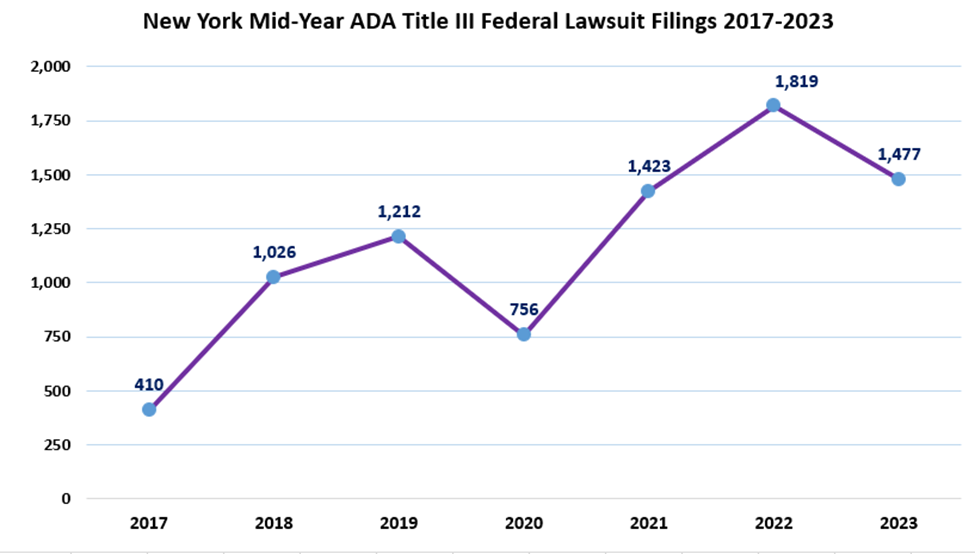
New York has continued to lead the nation in ADA Title III filings.  In 2022, the Empire State stood at 1,819 filings at the end of June and at 3,173 at year’s end.  2023’s mid-year tally is 1,477 cases.  This is fewer than last year, but still ahead of the other states by a significant margin.  Florida, coming in third, had 740 filings—about half of New York.

New York has been a hot venue for ADA Title III filings for years now:

[New York Mid-Year ADA Title III Federal Lawsuit Filings 2017-2023: 2017: 410; 2018: 1,026; 2019: 1,212; 2020: 756; 2021: 1,423; 2022: 1,819; 2023: 1,477]

Here are the top five states with the highest number of cases filed so far this year:

[2023 Mid-Year Federal ADA Title III Filings for Top 5 States: PA: 127; TX: 130; FL: 740; CA: 1,020; NY: 1,477]

What is the reason behind the decrease in federal ADA Title III lawsuits?  There are likely a number of factors.  First, in ADA Title III cases filed in California plaintiffs routinely add state law claims for statutory damages under the Unruh Act and Disabled Persons Act.  Many California federal judges have recently dismissed these claims for monetary damages right out of the gate on the theory that they are an end run around more stringent state court filing requirements. This has made federal court a less attractive venue for plaintiffs.  Second, one California firm that used to file many hundreds of cases each year had some legal troubles of its own then lost quite a few attorneys in the past two years and filed fewer cases as a result.  Third, one prolific Florida law firm stopped filing cases after one of its attorneys became the subject of a disciplinary proceeding and was recently suspended from the practice of law for six months.  Some of the unsavory findings from this disciplinary proceeding may have dampened the enthusiasm of some other plaintiff’s attorneys to file ADA Title III lawsuits.  Finally, earlier this year, the U.S. Supreme Court agreed to hear a case about the standing of serial plaintiffs which could make it harder for them to continue filing hundreds of lawsuits a year.  Attorneys representing these plaintiffs may be holding off on filing new cases while SCOTUS decides this issue.

Our Methodology:  Our overall ADA Title III lawsuit numbers come from the federal court’s docketing system, PACER.  However, because the area of law code that covers ADA Title III cases also includes ADA Title II cases, our research department reviews the complaints to remove those from the count.

Synopsis:  SCOTUS denies serial plaintiff’s attempt to dismiss her case and avoid the court’s consideration of a critical legal issue in ADA Title III lawsuits – tester standing.

U.S. Supreme Court Building

As we reported several weeks ago, serial plaintiff Deborah Laufer tried to evade the U.S. Supreme Court’s (SCOTUS) consideration of a very important legal issue —the standing of testers — by dismissing her case in the district court and then asking SCOTUS to dismiss her case as moot.  She claimed that she was dismissing all of her pending ADA Title III lawsuits because she did not want the allegations of misconduct against her prior counsel, Tristan Gillespie, to “distract from the merits of her ADA claims and everything she has sought to achieve for persons with disabilities like herself.”

Acheson Hotels, the Petitioner in the SCOTUS proceeding, vigorously opposed the dismissal request, arguing that Laufer was “abandoning her case to pave the way for Laufer and similar plaintiffs to resume their campaign of extortionate ADA suits against unwitting small businesses without the hindrance of an adverse ruling from this Court.”  Acheson’s brief further argued that the “Court should not reward Laufer’s effort to insulate lower-court rulings upholding ‘tester’ standing from Supreme Court review.” 

Just yesterday, SCOTUS issued the following Order:  “The respondent’s request that the Court dismiss the case as moot at this time is denied. The question of mootness will be subject to further consideration at oral argument in addition to the question presented.” 

In short, it seems SCOTUS may well consider the very important question presented by this case:  Whether a self-appointed Americans with Disabilities Act “tester” has Article III standing to challenge a place of public accommodation’s failure to provide disability accessibility information on its website, even if she lacks any intention of visiting that place of public accommodation.  Laufer had to move forward with filing her brief on the merits on August 2, 2023 and the matter is now fully briefed.

Oral argument is set for October 4, 2023.

Open laptop with hands pointing to the screen.

Seyfarth Synopsis: Department of Justice (DOJ) issues proposed website accessibility regulations applicable to state and local governments under Title II of the ADA.

Almost precisely a year after the Department of Justice (DOJ) announced its intent to begin the rulemaking process to enact website accessibility regulations applicable to state and local governments under Title II of the Americans with Disabilities Act (ADA), the DOJ has published its Notice of Proposed Rulemaking (NPRM) to the Federal Register for publication today, August 4, 2023.

We will follow up with another post with more substantive analysis, but here are some key points from the NPRM:

  • Entities Covered.  The proposed regulation would apply to public entities as defined by Title II of the ADA, which means state and local governments, as well as any department, agency, special purpose entity, or other instrumentality of a state, or state or local government.
  • Digital Properties Covered.  The content of websites and mobile apps, and specifically the information and sensory experiences (such as text, images, sounds, controls, and animations) that websites and mobile apps convey, as well as conventional electronic documents posted there, such as PDFs, Word documents, and Excel files.  Such web content that a public entity makes available to the public, or uses to offer its services, programs, or activities to the public, would be covered. 
  • Accessibility Requirements.  Covered websites and mobile apps will need to comply with the Web Content Accessibility Guidelines (WCAG), Version 2.1, Levels A and AA.
  • Timeframe For Compliance.  Within two years of the publication of the final rule, public entities with a population of 50,000 or more (as per the U.S. Census) would need to comply.  Public entities with a population of less than 50,000, as well as special district governments (public entities that perform designated functions) would have up to three years to comply.
  • Exceptions.  Critically, there are a number of exceptions, both with general application, and directed at specific types of public entities.  We summarize the key exceptions to the WCAG 2.1 AA conformance requirement as follows:
    1. Fundamental Alteration/Undue Burden.  The requirements do not apply to any actions that would result in a fundamental alteration of a service, program, or activity of a public entity, or impose an undue financial and administrative burden.  That determination would need to be made by the head of the public entity or his or her designee, and set forth in writing;   
    2. Archived Web Content.  Content maintained exclusively for reference, research or recordkeeping (among other factors), as well as pre-existing conventional electronic documents (Word documents, Excel files, etc.) would not be covered, except for electronic documents that are used by the public to gain access to government programs, services or activities;
    3. Third Party Content.  Content posted by a third party that is available on a covered website or mobile app;
    4. Linked Third Party Content.  Web content by third parties that is linked to a covered website or mobile app also would not be covered, unless used by the public entity to allow the public to access its services, programs or activities; and
    5. Certain Password-Protected Files.  Certain online documents protected by passwords that are unique to the individual, or documents or information related to the coursework of a public school, college or university, would be excluded as well, subject to further conditions and exceptions.

The proposed regulations also provide that a public entity can alternatively use a “conforming alternate version” of a covered website or mobile app as defined by WCAG 2.1, or provide “equivalent facilitation” to provide access, which means using alternative designs, methods or techniques that result in substantially equivalent or greater accessibility and usability of the website or mobile app for individuals with disabilities. Public comments are due no later than October 3, 2023.  Stay tuned for further updates and analysis.

By Minh N. Vu

Seyfarth Synopsis:  The Plaintiff in Acheson v. Laufer dismisses her lawsuit with prejudice and asks SCOTUS to dismiss its pending review based on mootness.

In an unexpected and bizarre turn of events, Deborah Laufer, the plaintiff in the much-watched Acheson v. Laufer case pending before the U.S. Supreme Court (“SCOTUS”), has decided to dismiss that case and all of her other pending ADA Title III lawsuits with prejudice.  What is more, she filed a brief in the matter before SCOTUS stating that her case is now moot and should be dismissed.  The hotel defendant, Acheson, intends to oppose the requested dismissal.

Ms. Laufer’s stated reason for abandoning all of her pending ADA Title III lawsuits is the bizarre aspect of this recent development.  In her brief, she informed SCOTUS that an attorney who had represented her in the past in unrelated ADA Title III cases, Tristan Gillespie, had recently been suspended from the practice of law by the U.S. District Court for the District of Maryland for unethical behavior.  She told SCOTUS that she did not want “the allegations of misconduct against Mr. Gillespie” to “distract from the merits of her ADA claims and everything she has sought to achieve for persons with disabilities like herself.  She accordingly has decided to dismiss all of her pending cases with prejudice.” 

A review of the Order suspending Mr. Gillespie and Report and Recommendation (the “Report”) from the three-judge panel that presided over disciplinary proceeding reveals unsavory details of one law firm’s handling of its ADA Title III “tester” litigation.  The thirty-one page Report recounts that Mr. Gillespie worked for the Thomas Bacon P.A. firm when he filed hundreds of ADA Title III lawsuits on behalf of Laufer and another disabled individual while simultaneously working full-time as an Assistant District Attorney for Fulton County, Georgia.  The Bacon Firm had filed over 600 lawsuits on behalf of Laufer and nearly 200 for the other tester plaintiff.  In fact, Thomas Bacon of the Bacon Firm represented Laufer before SCOTUS until this most recent filing requesting dismissal of the matter.

Among other findings, the court in the Gillespie disciplinary proceeding found that Gillespie (1) inflated his hours in many fee petitions, (2) never discussed the terms of any settlement agreements with his clients (instead giving them to his investigator/“expert”, Daniel Pezza, to collect signatures), (3) dismissed over 100 pending ADA lawsuits before his disciplinary hearing without consulting with his clients who were the plaintiffs in the actions, and (4) made payments to his investigator and so called “expert” Pezza who also happened to be the father of Laufer’s grandchild, thereby raising the possibility that Gillespie was inappropriately sharing fees with Laufer, in violation of ethics rules.  The Report stated that the “arrangement smacks of purchasing an interest in the subject matter of the litigation in which the lawyer is involved” and was, therefore, “highly problematic.”  However, as Laufer’s relationship with Pezza did not come to light until the end of the investigation, the Court did not make any findings on whether Laufer received any money from Pezza.  Laufer submitted a Declaration in the SCOTUS matter denying that she ever received money from Pezza.

The Report is a must-read for lawyers representing ADA Title III serial plaintiffs as the Court examined in great detail the types of questionable practices that should be avoided, such as the making of demands for attorneys’ fees in settlement agreements that are much higher than the fees actually incurred.  Gillespie tried to argue that his inflated fee demands represented future fees to be incurred for monitoring compliance, but the court was not persuaded.

Returning to the pending lawsuit before SCOTUS, it is unclear whether the Court will dismiss this case – the first ADA Title III case to reach the high court in eighteen years — because it is moot.  While that is the most likely outcome under ordinary circumstances, the unsavory facts surrounding Laufer’s mass voluntary dismissal, along with the sharp conflict among the Courts of Appeals concerning the standing of ADA Title III “testers” to assert claims, present a strong case for SCOTUS to move forward with its review. 

Stay tuned for developments.

Edited by Kristina Launey and John Egan

By Minh Vu and Lotus Cannon

Seyfarth Synopsis:   New Eleventh Circuit decision says amusement park operators must base rider eligibility requirements on actual risks and cannot simply adopt manufacturer recommendations, even when required by state law.

How many natural limbs must a person possess to ride a roller coaster or other thrill-ride at an amusement park?  Until now, many parks simply adopted manufacturer recommendations, as required by state law.  A recent Eleventh Circuit decision upends this practice, demanding manufacturers and/or amusement parks conduct safety assessments that are tailored to specific rider eligibility requirements.

In Campbell v. Universal City Development Partners, Ltd. the plaintiff sued a waterpark under Title III of the ADA (“ADA”) after the park would not let him ride an aqua coaster because he did not meet the rider eligibility requirement of two natural, grasping hands.  (The plaintiff does not have a right hand and does not use a prosthetic.)  The plaintiff alleged that the park’s requirement violated the ADA which prohibits the imposition of discriminatory eligibility criteria unless those criteria are “necessary.”  The District Court for the Middle District of Florida granted the park summary judgment, finding that the criteria were “necessary” under the ADA because they were created by the ride’s manufacturer and Florida law requires compliance with manufacturer requirements.   The district court reached this conclusion even though the manufacturer had not identified any specific risks for riders with missing limbs. 

The district court holding did not sit well with the U.S. Department of Justice (DOJ) which filed an amicus brief in support of the plaintiff. The Eleventh Circuit also did not agree with the district court, vacating judgment for the park and remanding the case for further proceedings. 

In reaching its decision, the Eleventh Circuit first held that the park bore the burden of proof to show that the limb requirement was “necessary.”  Second, the Court held that following state law mandating compliance with manufacturer requirements did not make the requirement “necessary” because state law cannot trump federal law (in this case, the ADA) when the two conflict. Third, the Court rejected the argument that compliance with manufacturer requirements is “necessary” because manufacturers have a comparative advantage in identifying safety risks.  The Court noted that the manufacturer had not actually identified any “actual risk” for people who are missing limbs.  The only safety risk that the manufacturer had identified relating to riders with disabilities concerned the impact of prosthetic limbs falling from the ride and striking someone, and as well as risks for riders with sight disabilities.  The Court said: “[W]e hold that a manufacturer-imposed safety requirement is ‘necessary’ only to the extent it is related to actual risks to the health and safety of guests.”  Finally, the Court stated that the need for administrative efficiency did not make the criteria “necessary” because the criteria themselves were not based on actual risk.

While this decision requires amusement parks to do more than just rely on manufacturer eligibility requirements, it does not prevent them from imposing legitimate eligibility requirements on riders based on actual risks.  The problem in this case was that no relevant risk assessment had been conducted by the public accommodation or manufacturer to justify the limb requirement.  

The decision also contains some useful nuggets.  For example, the Court recognized that “necessary” eligibility criteria include those that protect the health safety of the person with a disability, not just the health and safety of other riders.  This is a win for public accommodations because the current regulations only allow for the exclusion of individuals with disabilities when their participation poses a “direct threat” to the health and safety of others.   Further, the Court concluded that the term “necessary” includes more than what is required for safety and could include administrative feasibility.  On this issue, the park argued that it needed to rely on manufacturer requirements because it could not make individualized assessments for every rider.  The Court said it did not need to address this issue because the manufacturer requirement itself was lacking (i.e., not based on an assessment of “actual risk”) so the case did not present the question of whether a legitimate rider requirement could be applied to all similarly situated riders.

In sum, amusement parks should be reviewing rider eligibility requirements that impact people with disabilities to see if they are based on an assessment of actual risks.  If not, they should revise those rider requirements or conduct/commission additional risk assessments.

Edited by Kristina Launey