
 Florida is one of the top states for ADA Title III filings. As we previously reported, in 2015, California, Florida, New York, Texas, and Arizona had 3,847 ADA Title III lawsuits. This accounts for 80% of the lawsuits filed nationwide. Businesses are complaining, and the news media is paying attention. Miami Local 10 News, an ABC affiliate, reported on
Continue Reading Miami Local 10 News Reports On ADA Title III Drive-By Lawsuits
Lack Of Website Accessibility Regulations Is No Bar To Suit, Another Judge Affirms
 There is more bad news for businesses that thought that they could wait for the Department of Justice (DOJ) to issue specific regulations before making their websites accessible to individuals with disabilities. Federal Magistrate Judge Robertson in the District of Massachusetts recently denied motions by Harvard and MIT to dismiss or stay website accessibility class action lawsuits, and recommended that
Continue Reading Lack Of Website Accessibility Regulations Is No Bar To Suit, Another Judge Affirms
Seyfarth Insights Featured In Media Coverage Of Access Issues
 Over the past few weeks, our Title III Specialty Team contributed to the following pieces:
The site LXBN.com interviewed Seyfarth’s ADA Title III Team leader Minh Vu for an article about a pending lawsuit brought by an advocacy organization for the deaf against seven Hollywood movie studios for failing to provide closed captioning for lyrics of songs in motion pictures.
Continue Reading Seyfarth Insights Featured In Media Coverage Of Access Issues
ADA Title III Lawsuits Continue to Rise: 8% Increase in 2015
Our research department has crunched the numbers from the federal court docket and the verdict is that the ADA Title III plaintiff’s bar and their clients are still busy filing lawsuits. Here are the findings:
- In 2015, 4,789 ADA Title III lawsuits were filed in federal court, as compared to 4,436 in 2014. That 8% increase is modest compared to
Continue Reading ADA Title III Lawsuits Continue to Rise: 8% Increase in 2015
Nine U.S. Senators Urge Obama Administration to Issue Title III Website Regulations ASAP
By: Minh Vu
 In late December, nine Democratic senators (Edward J. Markey (D-Mass), Elizabeth Warren (D-Mass.), Sherrod Brown (D-Ohio), Cory A. Booker (D-N.J.), Barbara A. Mikulski (D-Md.), Richard Blumenthal (D-Conn.), Benjamin L. Cardin (D-Md.), Al Franken (D-Minn.) and Richard J. Durbin (D-Ill.)) sent a joint letter to the Office of Management and Budget (OMB) requesting that office “complete its review”
Continue Reading Nine U.S. Senators Urge Obama Administration to Issue Title III Website Regulations ASAP
U.S. General Services Administration Settles Suit Alleging Inaccessibility of Its Website for Contractors
 Oh, the irony. Our federal government is filing lawsuits against private businesses and universities for having allegedly inaccessible websites and mobile apps when its own agencies have inaccessible websites. In April 2014, we reported that the American Council of the Blind (ACB) and three blind federal contractors sued the General Services Administration , alleging GSA’s own website, SAM.gov, is inaccessible
Continue Reading U.S. General Services Administration Settles Suit Alleging Inaccessibility of Its Website for Contractors
ADA Title III Lawsuit Numbers Hold Steady for First Half of 2015
We’ve done the review and crunched the numbers: It appears that the surge of ADA Title III lawsuits we saw from 2013 to 2014 is holding strong, though possibly leveling off.
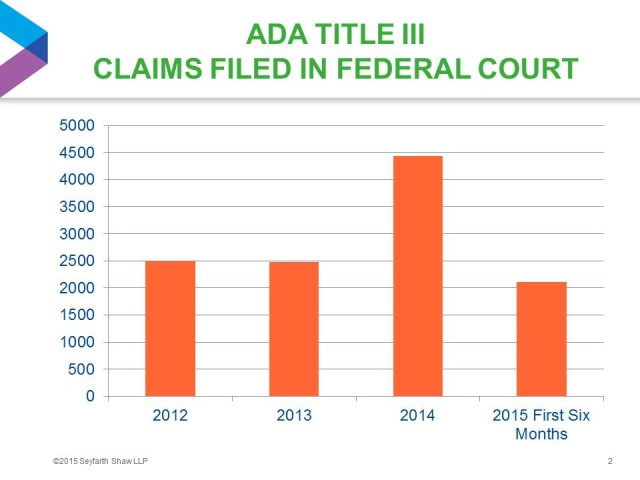
You may recall that there was a 60% increase in the number of ADA Title III lawsuits between 2013 and 2014 (2479 vs. 4436). In the first six months
Continue Reading ADA Title III Lawsuit Numbers Hold Steady for First Half of 2015
Federal Lawsuit Challenging Uber X’s Exclusion of Service Animals Shifts into Discovery
 By Kristen Verrastro and Andrew McNaught
Recently, a Federal court in Northern California denied Uber Technologies, Inc.’s request to dismiss an access lawsuit. The plaintiffs, National Federation of the Blind of California (“NFBC”) and individual blind members with guide dogs, filed an ADA lawsuit alleging Uber-X drivers committed various forms of discrimination, including refusing to transport blind riders with their service animals.
For example, one blind member of NFBC alleged an Uber-X driver pulled up to the curb; yelled “no dogs;” and then cursed at him before taking off without the NFBC member in the driver’s vehicle. The complaint also alleges that Uber-X drivers have mishandled guide dogs, in one instance even forcing a guide dog into the closed trunk of a sedan before transporting the blind rider. When the blind rider realized where the Uber-X driver placed her dog, she pleaded with the driver, who refused to pull over so the rider could remove the dog from the trunk.
Below, we discuss the arguments considered by the Court regarding Uber’s motion to dismiss. The Court ultimately determined that: (1) the plaintiffs had standing under the ADA; and (2) Uber may be subject to the ADA, potentially as a place of “public accommodation.”
Plaintiffs’ Standing under the ADA
Uber argued that the plaintiffs did not have standing to bring the lawsuit because, among other state law arguments: (1) one plaintiff did not have standing under the ADA’s deterrent effect doctrine; and (2) another plaintiff did not have standing as to the likelihood of future harm under the ADA.
The Court rejected Uber’s arguments. In finding that plaintiffs have standing under the ADA, the Court noted that the plaintiffs shouldn’t have to engage in a “futile” attempt to access services when they: (1) have knowledge that Uber has refused service to passengers with service animals; and (2) believe there is a likelihood such refusals will continue. Specifically, the Court said that “the ADA directs this Court to relax its standard for injury in fact in order to discourage both piecemeal litigation and futile attempts at access” when plaintiffs have actual notice of the alleged discriminatory practice and are in fact deterred from attempting access.
The Court also granted NFBC associational standing to bring suit under the ADA on behalf of its members.
Uber May Be Subject to the ADA
Continue Reading Federal Lawsuit Challenging Uber X’s Exclusion of Service Animals Shifts into Discovery
The Economist Highlights Seyfarth's ADA Title III Lawsuit Data
By Minh N. Vu
We are pleased to report that The Economist took an interest in our research which showed a 63% surge in the number of ADA Title III lawsuits filed in 2014. The Economist published an article (to come out in the print edition on April 25) entitled “Hobbling businesses: A law designed to help people with disabilities
Continue Reading The Economist Highlights Seyfarth's ADA Title III Lawsuit Data
ADA Title III Lawsuits Surge by More than 63%, to Over 4400, In 2014
By Minh N. Vu and Susan Ryan
In August 2014, we reported that the number of ADA Title III lawsuits filed against public accommodations rose by nearly 9% in 2013 over 2012. At that time, we predicted that there could be a 40% increase in the number of lawsuits filed in 2014 based on 6 months of data. Now that
Continue Reading ADA Title III Lawsuits Surge by More than 63%, to Over 4400, In 2014