By: Minh N. Vu and John W. Egan

Seyfarth Synopsis:  There will be no new regulations for accessible equipment/furniture or public rights of way issued during this Administration.

As we had predicted, no new ADA regulations will issue during the current Administration.  On September 11, 2025, the DOJ announced in the Federal Register that it would not be pursuing 54 pending regulatory actions.  Two of those concern the ADA: (1) A rulemaking about accessible equipment and furniture in public accommodations and state and local government facilities, and (2) a rulemaking concerning accessible routes in public areas falling under the jurisdiction of state and local governments.

While the inaction may appear helpful to cover entities at first blush, it is not necessarily so.  Public accommodations still have to make reasonable modifications to their normal policies and procedures under Title III of the ADA where necessary to ensure access for individuals with disabilities, and providing equipment and furniture that such individuals can use could fall under that obligation.  For instance, in 2021, a plaintiff sued a hotel about the height of its beds in accessible rooms and the court refused to dismiss the case because of the reasonable modification provision, even in the absence of a regulation specifying the height of an accessible bed.  The DOJ sided with the plaintiff in a Statement of Interest filed in the case. 

Additionally, state and local government entities have an obligation under Title II to provide services, programs, or activities that are accessible.  That includes pedestrian and vehicular areas such as public sidewalks and walkways, curb ramps, pedestrian signals, and on-street parking.  There has been litigation over the application of Title II of the ADA to these so-called public “right of way” elements, including a noteworthy decision by a federal court in 2021 requiring the City of New York to install thousands of accessible pedestrian signals at crosswalks for the benefit of individuals with visual disabilities.

The DOJ halted these regulatory actions to comply with Executive Order 14192 which imposes a regulatory cap for fiscal year 2025 and instructs the heads of all agencies ‘‘to ensure that the total incremental cost of all new regulations’’ issued during the year is ‘‘significantly less than zero.’’  Additionally, any new incremental costs must ‘‘be offset by the elimination of existing costs associated with at least 10 prior regulations.’’

Edited by: Kristina M. Launey
By: Minh N. VuKristina M. Launey, and Susan Ryan

Seyfarth Synopsis: Mid-year federal lawsuit counts show a continued rebound trend from 2023’s low.

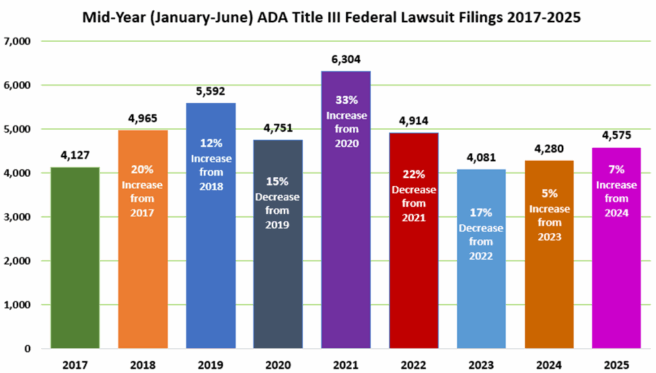
Since we started tracking ADA Title III lawsuits filed in federal courts at the mid-point of the year in 2017, we’ve seen ebbs and flows of activity in the first six months of each year.  In 2021 we saw the high water mark, with 6,304 cases filed.  Only two years later, in 2023, cases were at their lowest, with only 4,081 filings.  Last year, the numbers rebounded a little, and this year, that tide continues to rise.

In 2024, 4,280 ADA Title III cases were filed in federal courts between January and June.  In 2025, that number climbed to 4,575.  That’s a 7% increase year-over-year.  Nothing like the 33% increase between 2020 and 2021, but not a downturn either.  If the filing numbers remain steady for the rest of the year, 2025 will see approximately 9,100 cases which would represent a 3.4% increase over 2024 when there were 8,800 federal ADA Title III case filings.

[Mid-Year ADA Title III Federal Lawsuit Filings 2017-2025; 2017: 4,127; 2018: 4,965, 20% Increase from 2017; 2019: 5,592, 12% Increase from 2018; 2020: 4,751, 15% Decrease from 2019; 2021: 6,304, 33% Increase from 2020; 2022: 4,914, 22% Decrease from 2021; 2023: 4,081, 17% Decrease from 2022; 2024: 4,280, 5% Increase from 2023; 2025: 4,575, 7% Increase from 2024]

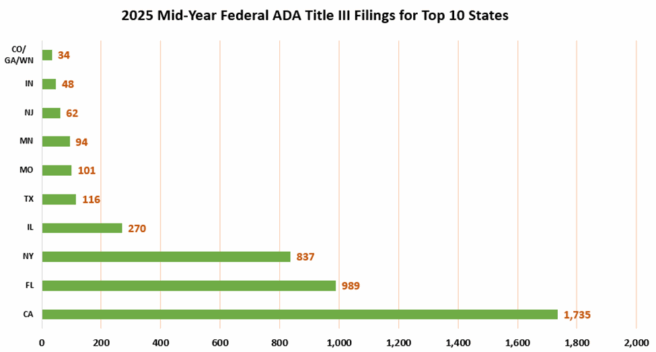
Here are the top ten states with the highest number of cases filed so far this year:

[2025 Mid-Year Federal ADA Title III Filings for Top 10 States: CO/GA/MN: 34; IN: 48; NJ: 62; MN: 94; MO: 101; TX: 116; IL: 270; NY: 837; FL: 989; CA: 1,735]

California had by far the highest number of filings, with 1,735.  Florida follows with 989, and New York, with 837.  Although Florida overtook New York in the second position, the real surprise is in fourth place: Illinois moved up from sixth last year.  Texas is in fifth place, with 116 cases filed.  Rounding out the top 10 are: Missouri (101), Minnesota (94), New Jersey (62), Indiana (48) and a 3-way tie for 10th: Colorado, Georgia and Wisconsin – all with 34 filings each.

Illinois is the big surprise this year – and likely took some of New York’s market share, as we’ve seen some New York law firms that used to file significant numbers of cases in New York now filing in Illinois.  This may be due to judges in New York becoming increasingly frustrated with website accessibility lawsuits, and looking at the cases more critically.  The increasing number is also a bit surprising given that we’ve seen and predicted that plaintiffs’ attorneys will focus more on filing in state courts. We do not track state court filing numbers due to lack of a reliable system to pull that data, but anecdotally have seen that trend.

Check back with us in early 2026 when we’ll have final numbers for the entire year.

Our Methodology:  Our overall ADA Title III lawsuit numbers come from the federal court’s docketing system, PACER.  However, because the area of law code that covers ADA Title III cases also includes ADA Title II cases, our research department reviews the complaints to remove those from the count.

Seyfarth Synopsis: Disability advocates issue demands to retailers about their allegedly inaccessible websites shortly after the EAA takes effect.

By: John W. Egan, Yana Komsitsky, Kristina M. Launey, and Minh N. Vu.  

U.S. businesses that provide consumer facing websites and mobile apps to customers in the European Union should take note that the European Accessibility Act (“EAA”) took effect on June 28, 2025.  The EAA also applies to some consumer technologies such as hardware systems and operating systems, self-service equipment, and e-readers. 

The EAA requires all 27 EU Member States to ensure that certain consumer facing technology products, e-commerce websites and mobile apps, comply with the uniform accessibility requirements in the EAA.  Member States must set penalties for non-compliance that are “effective, proportionate and dissuasive,” appoint at least one competent authority to enforce the requirements and provide a pathway for consumers and others to submit complaints of non-compliance to such authorities or the courts.  

Because each member state must set up its own enforcement framework, approach to enforcement will not necessarily be uniform across the EU.  However, penalties must take into account the seriousness of the violation, the number of non-complying products or services involved and the number of persons affected.  Depending on the country of enforcement, noncompliance may result in a fine and personal liability for officers, directors and managers.  In addition, non-compliant websites and mobile apps may be shut down and products may be removed from the market.  

Complaints by persons with disabilities or advocacy groups can trigger enforcement actions.  For example, days after the June 28 effective date, the French associations for the visually impaired and blind, ApiDV and Droit Pluriel announced that they had notified four major French retailers that their websites and/or mobile apps providing online shopping were not accessible in several ways, in violation of the EAA. The associations informed the retailers that if they do not make their online shopping services accessible by September 1, 2025, they will bring legal actions in court.

The EAA also applies in some business-to-business contexts by requiring certain products and services to be accessible.  Thus, manufacturers, importers, distributors, and service providers – at many different junctures in the stream of commerce – may also find themselves embroiled in EAA compliance issues.

The bottom line is that U.S. businesses that place consumer-facing technology products on the EU market, or provide services to EU consumers via e-commerce websites and/or mobile apps, should be assessing the EAA’s impact on their business if they have not done so already.  

By: Minh N. Vu and John W. Egan

Seyfarth Synopsis: The Department of Energy recently issued a fast-track proposed rule that would eliminate accessibility standards for facilities of recipients of federal funding under Section 504 of the Rehabilitation Act.  Are the ADA Title III regulations next?

On May 16, 2026, the United States Department of Energy (“DOE”) published a Notice of a Direct Final Rule entitled, “Rescinding New Construction Requirements Related to Nondiscrimination in Federally Assisted Programs or Activities.”  Through this Notice, the DOE announced its intention to eliminate 10 C.F.R. § 1040.73, a federal regulation that requires recipients of federal financial assistance (“Recipients”) to design and construct new and altered facilities in compliance with the Uniform Federal Accessibility Standards (“UFAS”).  UFAS contains detailed accessibility design standards, much like the 2010 ADA Standards for Accessible Design (“2010 Standards”) which apply to public accommodations and commercial facilities.

DOE’s stated rationale is that the regulation to be rescinded is “unnecessary and unduly burdensome” because there is already a “general prohibition on discriminatory activities and related penalties” in Section 504 of the Rehabilitation Act and its implementing regulations. The Notice further states that it is “DOE’s policy to give private entities flexibility to comply with the law in the manner they deem most efficient” and “one-size-fits-all rules are rarely the best option.”  The Notice indicates that the recission is consistent with Trump Administration policies and directives outlined in Executive Order 14154 (“Unleashing American Energy”), Executive Order 14192 (“Unleashing Prosperity Through Deregulation”), and the Presidential Memorandum entitled, “Delivering Emergency Price Relief for American Families and Defeating the Cost-of-Living Crisis.”      

Under the expedited Direct Final Rule process which is typically reserved for non-controversial regulatory actions, this proposed rule will be become final and effective on July 16, 2025 unless “significant adverse comments” were received by June 16, 2025.  If significant adverse comments were received, then the recission must go through full notice and comment rulemaking.  Over 20,000 comments have been submitted to the DOE in response to the Notice which would certainly suggest that there are significant adverse comments, but the website is not allowing visitors to view any of the comments.

Based on our practical experience in counseling clients on how to comply with the ADA’s accessibility requirements for facilities set forth in the 2010 Standards, we believe eliminating UFAS as a legal standard will actually be harmful for Recipients for a number of reasons, including but not limited to the following:  

  • Less Accessible Facilities and More Litigation Risk.  Design and construction professionals engaged by Recipients would be without guidance on how to construct facilities in an accessible manner as required by Section 504’s non-discrimination mandate. This will likely result in more facilities that are not useable to people with disabilities which, in turn, will create additional liability for Recipients.  Recipients will likely have to spend more money to make reasonable accommodations and physical modifications for employees with disabilities, and will face more lawsuits brought by members of the public with disabilities who are unable to access Recipients’ programs and services.
  • Less Accountability for Design and Construction Professionals.  Without an objective, enforceable standard for accessible design, Recipients will have difficulty holding design and construction professionals accountable for constructing and renovating facilities that are not accessible.
  • Eliminating a Safe Harbor for Lawsuits.  Presently, a Recipient that is sued for having an allegedly inaccessible facility can prevail by demonstrating that its facility complies with UFAS, even if that compliance still presents barriers for the specific plaintiff who brought suit.  UFAS is, in essence, a safe harbor for Recipients.  Without any accessibility design standard, Recipients will likely spend more money and resources litigating the issue of whether a property element or condition is accessible to people with disabilities generally — or worse, whether an element or condition was accessible to a specific, individual plaintiff.  

UFAS has been an enforceable standard for decades.  Like the ADA Standards, it is the product of a well-established process in which committees consisting of advocates, representatives of covered businesses and organizations, and government representatives meet, evaluate, and reach consensus.  The purpose of this system is to facilitate the development of technical design standards that balance considerations of cost and impact on covered entities with the accessibility needs of a diverse population of individuals with varying ability levels. These enforceable standards establish clear rules which businesses can use to plan, design, and price their projects.

In sum, while the idea of dispensing with hundreds of very specific design requirements may seem appealing at first blush to those who favor deregulation, the void it would leave will actually result in chaos and risk for Recipients – while producing a less accessible built environment for people with disabilities.  Courts will step in to fill the void, most likely with conflicting directives as we have seen in the digital accessibility arena where there is no legally enforceable accessibility standard for public accommodations.

Update:

On July 14, 2025, DOE issued a notice stating that

“Because DOE …received significant adverse comments on that direct final rule, DOE is extending the effective date to consider comments submitted in response to the direct final rule.”  While this is a temporary reprieve for the disability rights community, the DOE may still adopt the proposed rule with no further revisions.  The DOE went out of its way to say that “[t]o the extent that 5 U.S.C. 553 applies to this action, it is exempt from notice and comment because it constitutes a rule of procedure under 5 U.S.C. 553(b)(A) and for which no notice or hearing is required by statute.”  The DOE continues to maintain that its proposed action to rescind all accessibility design standards under Section 504 for its Recipients is “not a ‘substantive rule’ for which a 30-day delay in effective date is required under 5 U.S.C. 553(d).” 

Edited by: Kristina M. Launey

Tuesday, June 17, 2025
2:00 p.m. to 3:00 p.m. Eastern
1:00 p.m. to 2:00 p.m. Central
12:00 p.m. to 1:00 p.m. Mountain
11:00 a.m. to 12:00 p.m. Pacific

About the Program

Owners and operators of real estate – whether it be lodging facilities, shopping centers, retail stores, warehouses, or office buildings — must navigate the complex set of laws that prohibit discrimination against members of the public who have disabilities.  This webinar will explain how the Americans with Disabilities Act (ADA), the Fair Housing Act (FHA) and Section 504 of the Rehabilitation Act (Section 504) apply (or do not apply) to various property types, provide an overview of the key requirements, and offer practical guidance on how to comply and minimize litigation.

 Key topics include:

  • ADA, FHA, and Section 504 Requirements: Understanding the obligations of real estate owners under these laws
  • Debunking Common Myths:  Addressing the most widespread misconceptions
  • Common Landlord Pitfalls:  Understanding the most common pitfalls for landlords
  • Consequences of Non-Compliance: Exploring the legal ramifications of non-compliance and enforcement actions.

Speakers

Minh N.Vu, Partner, Seyfarth Shaw LLP
Michael E. Steinberg, Partner, Seyfarth Shaw LLP
Ashley S. Jenkins, Associate, Seyfarth Shaw LLP

By: John W. Egan and Minh N. Vu

Seyfarth Synopsis:  Two recent New York district court decisions underscore how serial website accessibility plaintiffs are encountering greater challenges to demonstrate their standing to pursue ADA claims in federal court.

SDNY Judge Orders Jurisdictional Discovery

In Fernandez v. Buffalo Jackson Trading Co., LLC, U.S. District Judge John P. Cronan granted the defendant’s request for jurisdictional discovery to be followed by an evidentiary hearing in connection with its motion to dismiss the complaint for lack of standing.  The hearing is set for May 28.

“Article III standing is not merely a pleading hurdle,” the Court observed in its decision, but instead “a core constitutional guardrail meant to ensure that federal courts decide only the rights of individuals, and that the federal courts exercise their proper function in a limited and separated government.” The Court further opined that “Article III does not permit plaintiffs to roam the country in search of … wrongdoing and to reveal their discoveries in federal court absent a genuine, personal stake in the outcome of the case.”

There were a number of factors that led the Court to question the “sincerity” of plaintiff’s allegations that he suffered an “injury in fact” while browsing the website and intended to return to the website at issue to make a purchase. 

First, the plaintiff filed dozens of “cookie-cutter, fill-in-the-blanks” complaints where he alleged that he went to a website to purchase some product, described a desire or need for the product, summarized some combination of features on the website that prevented his purchase, and asserted that he would return to make the purchase once the issue was corrected.  The Court also observed that the plaintiff’s firm used the same template pleading in cases filed by eight other plaintiffs.

Second, according to his numerous lawsuits, plaintiff allegedly attempted to purchase 40 products from dozens of websites in a single week.  The Court noted that these included the “Thompson leather moto jacket” at issue in the case, an “African Serpentine Necklace”, a “Bisonette Buffalo Leather Purse”, a “Synthetic Filled Puffy Comforter” and a “ProForce Combination Fist/Forearm Guard” from an online martial arts store, among many others.

Third, the Court noted inconsistences within the amended complaint itself.  The document alleged that the plaintiff wanted to buy the leather jacket in question because of its craftsmanship, functionality, and durability, along with the 10 percent discount offered for a first purchase.  The Court found it odd that the plaintiff was able to gather this information while claiming that the website was largely inaccessible in the first instance.

The Court was careful to note that the basis for its ruling was not whether the plaintiff could serve as a “tester” per se, as such litigants may have standing, but rather because the above issues warranted a more searching jurisdictional inquiry.  Accordingly, the Court declined to dismiss the action based on standing, but instead ordered limited discovery.  It suggested that plaintiff’s deposition and a forensic examination of the device or devices he used to access the website would be appropriate.  If plaintiff does not dismiss the case before then, we will report on the May 28 hearing.  

EDNY Judge Dismisses Website Case Based on Standing Sue Sponte

The day after the Buffalo Jackson Trading ruling, Eastern District of New York Judge Natasha Merle issued another defendant-friendly dismissal based on lack of standing. In Black v. 3 Times 90, Inc., the plaintiff alleged that he visited the website advertising Chinese restaurant locations because he enjoyed this type of cuisine, wanted to visit one of defendant’s locations “immediately” based on the recommendation of a friend, and often visits the neighborhoods where the restaurants are located.  

The restaurant owner moved to dismiss based on mootness.  The defendant argued it engaged a third-party vendor to remediate the barriers and thus there was no injunctive relief for the Court to award.

Rather than dismiss based on mootness, the Court ruled that the amended complaint failed to create a plausible inference that the plaintiff intended to return to the website, as required for a plaintiff to have standing to pursue an ADA Title III lawsuit. 

The Court found that the plaintiff failed to allege why the website barriers prevented or impeded him from visiting a restaurant location.  The Court also questioned plaintiff’s alleged desire to try food options “immediately” since, as alleged, the plaintiff often frequented neighborhoods where the restaurants were located, but never actually visited any to try the food.  It was also curious to the Court that the plaintiff did not attempt to find the menu or location information through any alternative means (other than attempting to access the defendant’s website) given the professed urgency.  Additionally, the Court pointed out that there are countless options for dumplings and unique dining experiences in New York City (both reasons cited by plaintiff to support plaintiff’s interest in the defendant’s business), but the amended complaint contained no explanation as to why there were no other options with these offerings.  Finally, though not cited as a factor in the standing analysis, the Court did mention in a footnote that the plaintiff had filed 27 lawsuits in the previous year.

Finding that the plaintiff had failed to allege facts establishing an intent to return to the website, the Court dismissed the Complaint.  The Court did so without granting leave to amend. 

***

The upshot of these decisions (and others on which we have reported) is that federal courts in New York City — after being barraged for a number of years with thousands of ADA website cases — are demanding more from serial plaintiffs to establish standing to sue.  This may be the reason why several plaintiff-side firms in New York have shifted most, if not all of their website accessibility lawsuits to New York State courts, where the standing requirements are less rigorous.  As we recently reported, the number of federal court filings in New York have decreased by almost a third since 2022, and the number of website accessibility lawsuits filed in New York federal court decreased by 39 percent.

Edited by: Kristina M. Launey  

By: Kristina Launey and Minh Vu

Seyfarth Synopsis: The FTC issued a Decision and Order prohibiting accessibility plug-in/Widget vendor AccessiBe from making misleading claims and to pay $1 million.

As the number of website accessibility lawsuit filings have exceeded 2,200 per year since 2018, so too has the list of companies offering solutions for making websites accessible to users who are blind or have other disabilities.  Because the process of auditing a website for accessibility issues and then remediating them by making actual changes to the source code can be expensive and time consuming, a number of businesses have emerged with quick and inexpensive “solutions” using overlays, widgets or plug-ins that claim to automatically make websites accessible to individuals with disabilities.  The actual efficacy of these methods or tools, as well as the related marketing claims of these vendors, have been the topic of heated debate in the digital accessibility community in recent years.  Many businesses – lured by the promise of an inexpensive solution – have paid for these automated accessibility tools even while some plaintiffs and advocacy groups insist that they do not work.

One of the most visible vendors in this space is accessiBe, which was the subject of a Federal Trade Commission (FTC) investigation.  On April 21, 2025, the FTC issued a Decision and Order (the “Order”) which, among other things, orders accessiBe to pay $1M and prohibits it from representing that its automated products can make any website compliant, or ensure continued compliance, with the Web Content Accessibility Guidelines (WCAG), unless it has the evidence to support its claims.  The Order also prohibits accessiBe from misrepresenting that statements in reviews, blog posts, or articles about its automated products are independent opinions by impartial users or organizations providing objective information.  The Order remains in effect for twenty (20) years, during which time accessiBe must file annual compliance reports with the FTC.

The Order resolves a detailed 27-page Complaint issued by the FTC which charged accessiBe with violating the Federal Trade Commission Act by falsely claiming that accessiBe’s widget (accessWidget) made all user websites WCAG-compliant.  According to the Complaint, accessiBe claimed that “installing accessWidget’s ‘one line of code’ makes a website compliant with 30% of WCAG’s requirements immediately and initiates an AI process that makes the website fully compliant with the remaining 70% of WCAG requirements within 48 hours.”  The Complaint alleged that “[c]ontrary to accessiBe’s promises, in a number of instances accessWidget fails or has failed to make basic and essential website components like menus, headings, tables, images, recordings, and more, compliant with WCAG and accessible to persons with disabilities.”  The Complaint further stated that accessiBe “made these advertising claims on its website and social media, as well as in paid advertisements” knowing that they “were deceptively formatted to appear like impartial reviews and articles.”  The Complaint contains detailed examples of the alleged violations. The FTC also blogged about the issue, noting “It’s advertising law 101: before you claim your product can perform a certain task, you need evidence it will work as promised.”

This development confirms our longstanding belief that businesses need to consult with counsel with experience in digital accessibility before investing in an accessibility solution, or hiring an accessibility consultant. 

By Kristina M. Launey & Minh N. Vu

Seyfarth Synopsis: Plaintiffs filed 2,452 website accessibility lawsuits in federal court in 2024 – a 13% decrease from 2023. 

Website accessibility lawsuits filed in federal court fell for the second consecutive year in 2024, with a significant decrease from 2023 filings.  The total number of lawsuits filed in federal court alleging that plaintiffs with a disability could not use websites because they were not designed to be accessible and/or work with assistive technologies in 2024 was 2,452.  This number is 342 fewer than 2023’s total of 2,749, representing a 13% decrease. 

[Graph: ADA Title III Website Accessibility Lawsuits in Federal Court 2017-2024: 2017: 814; 2018: 2,258 (177% increase from 2017); 2019: 2,256 (.01% decrease from 2018), 2020: 2,523 (14% increase from 2019); 2021: 2,895 (12% increase from 2020); 2022: 3,255 (12% increase from 2021); 2023: 2,794 (14% decrease from 2022); 2024: 2,452 (13% decrease from 2023). *The number of cases that could be identified through a diligent search.]

Website accessibility lawsuits accounted for 28% percent of the total number of ADA Title III lawsuits filed in federal court in 2024 (2,452 out of 8,800 cases).  In 2023, website accessibility lawsuits made up 34 percent of all the ADA Title III lawsuits filed in federal court (2,794 out of 8,227 cases).  Also, as shown in the graph below, the number of filings per month ranged from a low of 167 cases in April to a high of 261 cases in October. 

[Graph: Total Number of Website Accessibility Lawsuits Filed by Month (Jan. 2024 – Dec. 2024): Jan. 2024 (168), Feb. 2024 (210), Mar. 2024 (188), Apr. 2024 (167), May 2024 (203), Jun. 2024 (196), Jul. 2024 (179), Aug. 2024 (205), Sep. 2024 (230), Oct. 2024 (261), Nov. 2024 (220), Dec. 2024 (225). *The number of cases that could be identified through a diligent search.]

New York federal courts continued to be the busiest with 1,564 lawsuits.  Florida was a distant second with 470 lawsuits, up from 385 in 2023.  Minnesota came in third with 114 lawsuits.  Pennsylvania passed Illinois for the fourth spot with 103 lawsuits.  Illinois did manage to stay in the top 5 with 93 lawsuits.  Remarkably, California’s federal courts only had three new website accessibility lawsuits last year.

[Graph: Federal ADA Title III Website Accessibility Lawsuits per State, Jan. 2024 – Dec. 2024: NY 1,564, FL 470, MN 114, PA 103, IL 93, NJ 37, MO 35, WI 14, MA 10, IN 6, CA 3, NC 2, LA 1. *The number of cases that could be identified through a diligent search.]

[Graph: New York, Florida, Pennsylvania, and California Federal ADA Title III Website Accessibility Lawsuits 2017-2024: NY: 2017 (335), 2018 (1,564), 2019 (1,358), 2020 (1,694), 2021 (2,074), 2022 (2,560), 2023 (2,152), 2024 (1,564); FL: 2017 (325), 2018 (576), 2019 (529), 2020 (302), 2021 (185), 2022 (310), 2023 (385), 2024 (470); PA: 2017 (58), 2018 (42), 2019 (92), 2020 (173), 2021 (167), 2022 (216), 2023 (143), 2024 (103); CA: 2017 (9), 2018 (10), 2019 (121), 2020 (223), 2021 (360), 2022 (126), 2023 (30), 2024 (3).]

If you’re wondering why California has so few website accessibility cases relative to New York, it is likely because judges in New York federal courts have been more favorable toward plaintiffs when the defendant is an online-only business. Although the Court of Appeals for the Second Circuit has yet to decide whether online-only businesses are covered by the ADA, most district court judges in New York – with a few exceptions – to have addressed the issue have concluded that they are.   That said, New York federal courts have been more demanding lately with regard to the allegations necessary to establish a plaintiff’s standing.

In California, both federal and state courts of appeal have reached the conclusion that online only businesses are not covered by the ADA, making it virtually impossible for plaintiffs to file viable lawsuits against online-only businesses for accessibility violations.  Thus, we predict fewer website accessibility cases in both California state and federal courts in the future; though we still see a significant number of demand letters and lawsuits filed in state courts, which are not included in our federal lawsuit numbers, especially against businesses with physical locations.

Why was there an overall decrease in the number of website accessibility lawsuits filed in federal courts throughout the country last year?  While there is no way to know for certain, we think there are at least three possible factors in play. 

First, and most significantly, more and more plaintiffs’ firms responsible for historically significant numbers of filings have been filing website accessibility lawsuits in state courts instead of federal court.  Since these filings are difficult to track, it may well be that the total number of website accessibility lawsuits increased year-over-year when accounting for state court filings.  

Second, some of the plaintiffs’ lawyers who used to file a substantial number of these lawsuits have been less active in this space. 

Third, more businesses are making website accessibility a priority which, in turn, may have reduced the number of inaccessible websites to sue.   

One thing is likely certain:  Unless the present administration and/or Congress makes significant changes to the ADA Title III statutory, regulatory, or enforcement schemes – a highly unlikely scenario – website accessibility lawsuits will continue to be filed.  What the numbers will look like remains to be seen.   

***

About our methodology:  Our 2024 numbers are based on searches using keywords of data from the Courthouse News Services.  Thus, it is possible that there are some website accessibility cases that were not captured in the searches if their descriptions did not include the keywords.  We then review the thousands of entries manually to remove lawsuits that may be about websites but are not about a website’s accessibility to a user with a disability. 

Edited by John W. Egan

By: Minh N. Vu

Seyfarth Synopsis: A recent case from the U.S. District Court for the Middle District of Florida illustrates how businesses should handle scenarios where service animals present health risks to others with severe allergies.

We all know that public accommodations must allow service animals accompanying individuals with disabilities onto their premises, but what if doing so places others with severe allergies at risk?  A recent Florida federal court’s decision provides insight on how this scenario (and others involving “direct threats” to health and safety) should be handled.  

The plaintiff in this case used a dog which was trained to alert her to, and mitigate, self-harming behavior caused by post-traumatic stress disorder (“PTSD”), anxiety, and bipolar disorder.   Specifically, the dog would press on plaintiff’s body, lick and claw her to “ground” her during episodes of anxiety.  Based on these facts, the court concluded that the dog qualified as a service animal.  The plaintiff brought the service dog to an appointment with a new doctor.  When the doctor saw the dog, she informed her employee that she was severely allergic to dogs and could not see the plaintiff with the dog.  The employee then informed the plaintiff that she could either see the doctor while the service dog remained with her companion, or she could reschedule to see another doctor with the dog.  After the plaintiff became agitated and accused the medical practice of violating the ADA, the employee called the sheriff.

The court began its analysis by recognizing the Department of Justice’s guidance that “allergies are not enough to except a place of public accommodation from accommodating a service animal” and both the animal’s handler and the individual with allergies should be accommodated “by assigning them, if possible, to different locations within the room or different rooms in the facility.”  However, the court held that “[d]espite this rule, a service animal may nonetheless be excluded if it poses a direct threat to the health and safety of persons providing or receiving services from an accommodation.”  The court ultimately concluded that the medical practice had properly conducted “an individualized assessment” of the direct threat to the doctor and that its conclusion was objectively reasonable.  The court focused on the doctor’s testimony about her severe allergy to dogs, based on her prior consultation with her doctor and her own knowledge of her allergy and its symptoms.  The court also focused on the reasonable modifications offered to the plaintiff that would allow her to receive medical services, albeit from a different physician who did not have a dog allergy, which the plaintiff rejected.  It also considered the fact that the medical practice made a one-time decision “on the spot,” noting that the regulation requires only a “reasonable judgment” in determining if a direct threat exists under the circumstances.

There are a few important takeaways from this decision:

First, it highlights the importance of considering (1) the specific facts presented by a situation in assessing whether a service animal poses a direct threat to someone else at the public accommodation, and (2) measures that would allow the person with a service animal to receive services from the public accommodation while mitigating the risk to the health and safety of others.  In this case, the medical practice considered the severity of the doctor’s allergy, and offered other options which would have allowed the plaintiff to receive medical services. 

Second, this case was decided only after an evidentiary trial, underscoring the difficulty of securing early dismissals of these types of cases.  Thus, businesses that face unruly behavior by animals or animals that otherwise pose health risks should be thoughtful in handling these situations.  They should conduct a fact-specific, individualized assessment of the risk that includes an exploration of alternatives that would mitigate that risk but still provide equal access to their products and services.  The case also illustrates how businesses should be prepared to go the distance in litigation if necessary (i.e. summary judgment and/or trial) if they decide to exclude the animal on the basis of a “direct threat” that it presents.

Edited by: John W. Egan  

By: Ashley S. Jenkins and Minh N. Vu

Seyfarth synopsis: The Trump DOJ rescinded five COVID-19 related documents and six older guidance documents designed to educate businesses on the requirements of the ADA, claiming that the recission will reduce the burden on businesses to review them.

On March 19, 2025, to comply with President Trump’s January 20, 2025 memorandum “Delivering Emergency Price Relief for American Families and Defeating the Cost-of-Living Crisis”, the Department of Justice (“DOJ”) announced that, to “deliver price relief to consumers” it was withdrawing eleven guidance documents it had issued over the years to educate covered businesses on the requirements of the Americans with Disabilities Act (“ADA”) and how to implement them in their operations. The DOJ said “[t]oday’s withdrawal of 11 pieces of unnecessary and outdated guidance will aid businesses in complying with the ADA by eliminating unnecessary review and focusing only on current ADA guidance.”  It should be noted that neither the ADA nor DOJ required public accommodations to review these guidance documents in the first place.

The withdrawn guidances include 5 “question-and-answer” documents issued during the COVID-19 pandemic to assist individuals with disabilities and businesses in understanding their rights and obligations during that time, a 10-part training program called Reaching Out to Individuals with Disabilities that educates businesses on the various requirements of the ADA, and guidance documents specifically targeting hotels and lodging facilities, gas stations, and retail establishments.

The full list of eleven rescinded guidance documents are:

  1. COVID-19 and the Americans with Disabilities Act: Can a business stop me from bringing in my service animal because of the COVID-19 pandemic? (2021)
  2. COVID-19 and the Americans with Disabilities Act: Does the Department of Justice issue exemptions from mask requirements? (2021)
  3. COVID-19 and the Americans with Disabilities Act: Are there resources available that help explain my rights as an employee with a disability during the COVID-19 pandemic? (2021)
  4. COVID-19 and the Americans with Disabilities Act: Can a hospital or medical facility exclude all “visitors” even where, due to a patient’s disability, the patient needs help from a family member, companion, or aide in order to equally access care? (2021)
  5. COVID-19 and the Americans with Disabilities Act: Does the ADA apply to outdoor restaurants (sometimes called “streateries”) or other outdoor retail spaces that have popped up since COVID-19? (2021)
  6. Expanding Your Market: Maintaining Accessible Features in Retail Establishments (2009)
  7. Expanding Your Market: Gathering Input from Customers with Disabilities (2007)
  8. Expanding Your Market: Accessible Customer Service Practices for Hotel and Lodging Guests with Disabilities (2006)
  9. Reaching out to Customers with Disabilities (2005)
  10. Americans with Disabilities Act: Assistance at Self-Serve Gas Stations (1999)
  11. Five Steps to Make New Lodging Facilities Comply with the ADA (1999)

To further implement the Executive Order, the DOJ said it would highlight tax incentives that are available to businesses that make accessibility improvements.  The DOJ has added a link to a 2006 guidance about those tax incentives from the homepage of www.ada.gov. 

While the guidance documents issued during the COVID-19 pandemic are arguably no longer necessary, for those of us who specialize in this area of the law, they provided useful guidance on how certain legal principles in the ADA should be applied and interpreted outside of the COVID-19 context.  The other guidance documents may be older, but some of them still contain highly relevant information in areas where the law has not changed, and were useful explanation to businesses of how different parts of the ADA statute and regulations should be applied by businesses.  In short, while the recission of these guidance documents does not substantively impact the ADA’s requirements, it does beg the question of whether they will be replaced by new guidance documents that will take a more lenient and business-friendly approach to ADA compliance. 

Edited by Kristina Launey